

Sony Is Charging Different People Different Prices on PSN. And You Might Be Paying More.
Ever compared game prices with a friend and realized you're looking at completely different numbers? You're not losing your mind. Sony is running a massive pricing experiment on the PlayStation Store, and depending on which test group your account falls into, you could be paying significantly more (or less) than the person sitting next to you.
This isn't a bug. It's deliberate. And Sony hasn't said a single word about it.
What's Actually Happening
Starting in late 2024, Sony began quietly testing different prices for the same games on different PSN accounts. The practice was first spotted by data analysts at PSPrices.com, who discovered internal experiment tags buried in PlayStation's API responses. By November 2025, reports started hitting Reddit when users noticed price discrepancies between accounts in the same household. One widely shared example: a husband saw Red Dead Redemption 2: Ultimate Edition priced at $19.99 while his wife's account showed $14.99. Same console, same region, neither had PS Plus.
By March 2026, this thing had blown up. A post on r/mildlyinfuriating showed Assassin's Creed Unity listed at £3.74 when browsing logged out, then jumping to £9.99 after signing in. The gaming press picked it up. Push Square, Kotaku, Vice, VGC, Tom's Hardware, basically everyone ran coverage. And Sony? Complete silence.
The Numbers Are Staggering
This isn't a small test on a handful of titles. According to PSPrices' data analysis:
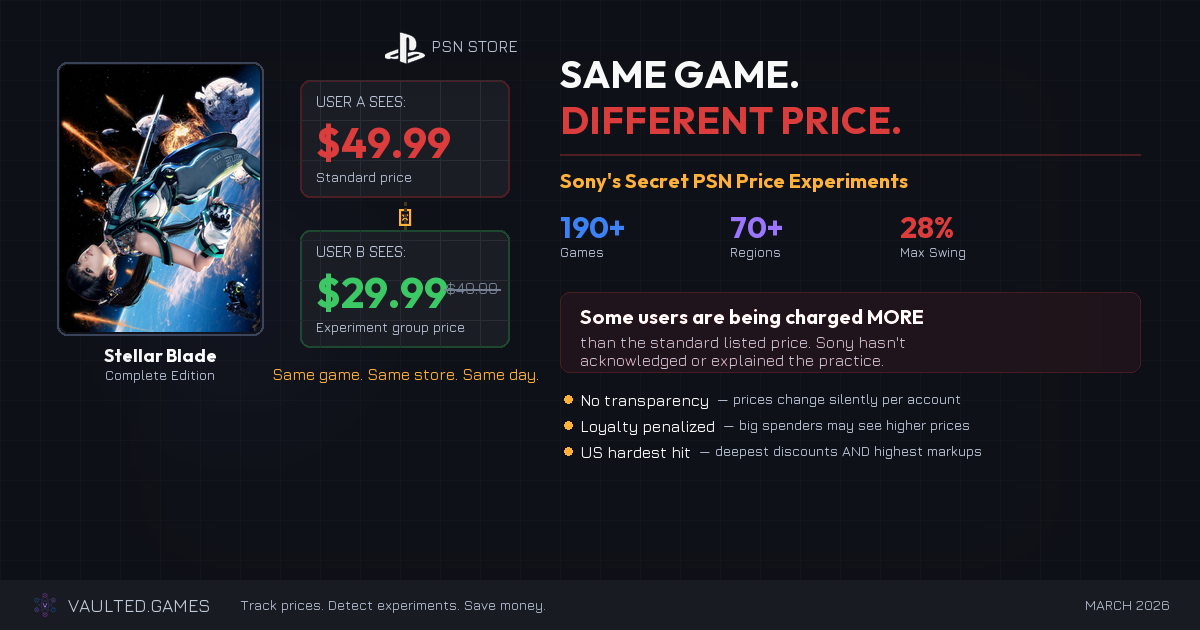
190+ games are currently in active price experiments across 70+ regions. Every single region where PlayStation operates is included except Japan (likely for regulatory reasons). The US market, PlayStation's biggest, was added in March 2026 with 104 games and the most aggressive testing program yet.
Price differences range from 5% to nearly 28% depending on the game, region, and which test group your account lands in. During one sale period, some users saw Helldivers 2 at 56% off while others got just 25% off for the exact same promotion.
The Three Experiment Programs
Digging into the technical side, Sony is running three distinct experiment programs, each identified by tags in their API:
IPT_PILOT was the first program, launched in late 2024. It started small with around 50 games in 30 regions, testing modest discounts. Think of it as Sony dipping their toes in the water.
IPT_OPR_TESTING expanded the scope significantly, covering more games and regions. Both PILOT and OPR_TESTING only test prices below the standard retail price. So users in these test groups see better deals than normal. Shady? Sure. But at least nobody was paying more than the listed price.
IPT_LTM is the one that has people genuinely furious. Launched in March 2026 and currently only active in the US, this program tests prices in both directions, including above the standard retail price. That means Sony is actively charging some users more than others for the identical product. 104 games are currently enrolled in IPT_LTM, and it's showing the widest price swings of any program (up to 27.8% variation).
Which Games Are Affected
The list includes major first-party Sony titles and big third-party games. Here's a sample of confirmed titles in testing:
| Game | Publisher | Observed Variation |
|---|---|---|
| God of War Ragnarok | Sony | Up to 12.5% |
| Marvel's Spider-Man 2 | Sony | Active in testing |
| Helldivers 2 | Sony | Up to 56% off vs 25% off |
| Stellar Blade Complete Edition | Sony | $30 vs $50 |
| WWE 2K25 | 2K Games | 17.6% variation |
| Warhammer 40K: Space Marine 2 | Focus Entertainment | 16.6% variation |
| Kingdom Come: Deliverance II | Deep Silver | 14.9% variation |
| Red Dead Redemption 2 | Rockstar Games | $19.99 vs $14.99 |
| Assassin's Creed Unity | Ubisoft | £3.74 vs £9.99 |
Sony's own games being in the experiment is telling. This isn't publishers running their own promotions. Sony is orchestrating the entire thing.
Why This Hits Different Than Other Industries
Airlines have done dynamic pricing for decades. Uber has surge pricing. Amazon tweaks prices constantly. So why is this generating so much anger?
There's no transparency. Xbox has been running personalized deals since 2021, but they label them "Just For You" so users know they're seeing a tailored offer. Sony shows you a price and acts like that's just what the game costs. When the price changes after you log in, there's no label, no explanation, nothing.
You can't shop around on PSN. If Amazon shows you a higher price, you can check Walmart, Target, or a dozen other retailers. PlayStation digital games can only be purchased through the PlayStation Store. There are no authorized third-party PSN key sellers for most titles. If Sony decides your account pays more, your only real option is to not buy.
It punishes loyal customers. Multiple data points suggest that accounts with higher spending history see worse deals. If you've been a loyal PlayStation customer buying games regularly, Sony may reward that loyalty by charging you more. One Push Square commenter put it perfectly: "Charging people more because they have history of buying more is a slap in the face."
It happened in secret. Sony didn't announce this. They didn't ask permission. They didn't even acknowledge it when the press started asking questions. Users had to discover it themselves through data mining and comparing accounts.
The Legal Gray Area
Dynamic pricing for digital goods sits in a murky legal space. It's not explicitly illegal in most jurisdictions, but it's not clearly legal either. Especially when you start showing one price to a logged-out user and a higher price after login.
The UK has particularly interesting implications. If a game appears at £3.74 on the storefront and then jumps to £9.99 when you add it to your cart, that could run afoul of consumer protection laws around advertised pricing. Multiple users have raised this exact concern.
The EU's upcoming Digital Fairness Act (draft expected Q3 2026) is expected to directly address personalized pricing in gaming. The regulation would require explicit disclosure when prices vary between users. If that passes, Sony would need to either stop the practice in EU markets or start being transparent about it.
In the US, there's less regulatory framework for this kind of thing. But public pressure and FTC scrutiny around "dark patterns" in digital marketplaces could put Sony under the microscope.
The Community Response
The gaming community is, predictably, pissed. Reddit threads about PSN dynamic pricing have thousands of upvotes and comments. The sentiment breakdown from major forums runs roughly 70% negative toward Sony, 20% skeptical/wanting more info, and about 10% defending the practice.
The most common takes boil down to:
"This is an anti-loyalty program." Heavy spenders get worse deals. New or light accounts get better ones. That's backwards from every other industry's approach to customer retention.
"This validates physical media." Digital-only consoles suddenly look a lot less appealing when the storefront can charge you whatever it wants with no alternative. Comments like "Excrement like this is why I refuse the all-digital future" are getting massive upvotes.
"Sony's silence makes it worse." Every major gaming outlet has reached out for comment. Radio silence. That's not a good look when your customers feel like they're getting screwed.
A small minority of defenders point out that the PILOT and OPR_TESTING programs only offer discounts below retail, meaning some users get better deals while nobody pays more than standard price. That's a fair point for those two programs. But IPT_LTM blows that argument apart entirely.
What Can You Do Right Now
Until platforms like ours can build proper tooling around this (more on that in a second), here are some immediate steps:
Check prices logged out. Open an incognito/private browser window and browse the PlayStation Store without signing in. Compare what you see to your logged-in prices. If they're different, you're in an experiment group.
Compare across household accounts. If multiple people in your home have PSN accounts, check the same game on each one. The Red Dead Redemption 2 discovery happened exactly this way.
Use price tracking sites. Services like PSPrices track historical pricing data and can flag when games are in active A/B tests. This at least gives you visibility into whether you're seeing the "real" price.
Consider other storefronts. If a game is available on multiple platforms, check Steam, Xbox, or physical retailers. When PSN shows you an inflated price, the best countermove is buying it somewhere else entirely.
Buy physical when possible. Physical game prices are the same for everyone. They're also resellable, lendable, and immune to whatever pricing experiments Sony decides to run next.
How Vaulted.Games Is Responding
We track game prices across PlayStation, Xbox, Steam, and Nintendo. We already have the infrastructure to monitor what's happening on PSN. And we're building new tools specifically designed to give you visibility and control over this situation. Here's what's in the works:
PSN Price Experiment Detection and Alerts
We already poll PSN prices as part of our core tracking. We're now extending that system to detect Sony's experiment tags (IPT_PILOT, IPT_OPR_TESTING, IPT_LTM) directly from the API. When we flag a game as being part of an active experiment, you'll see a clear notice on that game's page: "This game is currently in a Sony price experiment. The standard price is $X, but some users are seeing $Y."
You'll know immediately if the price you're seeing is the real price or a test price. No guesswork, no checking in incognito, no comparing accounts with your spouse. We surface it right there on the game page.
Fair Price Indicator
For every PSN game in our catalog that's part of an active experiment, we'll show the lowest confirmed price across all test groups right alongside the standard price. Something like: "PSN is showing this game at $39.99 to some users and $29.99 to others."
This is the single most important piece of information you need when deciding whether to buy. If you can see that other people are paying less for the exact same product, you can make an informed choice about whether to wait, buy elsewhere, or pull the trigger anyway.
Cross-Store Price Comparison
We already track prices across PSN, Xbox, Steam, and Nintendo. When PSN shows you an inflated price through one of their experiments, we can immediately surface alternatives: "This game is $49.99 on PSN for your account group, but $39.99 on Steam right now."
Dynamic pricing only works when consumers can't easily compare. We make it easy. If Sony is charging you more, we'll show you exactly where to buy it cheaper.
Enhanced Price Drop Alerts
Our existing price alert system is getting an upgrade to account for A/B testing. Instead of a simple "this game dropped to $X," you'll get context: "The PSN sale price for this game varies between $29.99 and $39.99 depending on your account group."
We're also adding cross-store intelligence to alerts. If we detect a better price on another storefront, we'll let you know: "We found a better price on Steam for a game on your PSN wishlist."
Experiment Tracker Dashboard
This is the big one. We're building a dedicated page that tracks every game currently enrolled in Sony's A/B testing. Which experiment program it's in, what price ranges are being tested, which regions are affected, and historical data on how experiments have played out.
Think of it as a real-time transparency report for PSN pricing. When Sony won't tell you what's going on, we will.
The Bigger Picture
Sony isn't the first company to try personalized pricing, and they won't be the last. This is the direction digital storefronts are moving, and it's going to get more aggressive as data collection and AI-driven pricing models improve.
The only real defense is transparency. When you can see what's happening, you can make informed decisions. You can wait for a fair price, buy on a different platform, or just say "screw it" and buy physical. But you can only do that if you know the game is being played in the first place.
That's what we're building toward. Not just price tracking, but price accountability. Because the price you see should be the price everyone sees.