
Digital Game Ownership: What You Actually Own (And What You Don't)
You spent $70 on a game. You downloaded it. It's sitting right there on your console. You own it, right?
No. You don't. And the gaming industry is counting on you not reading the fine print.
Every major platform, Sony, Microsoft, Valve, Nintendo, all of them, sells you a license to play a game. Not the game itself. That's a massive difference, and it's one that most gamers don't think about until their favorite game gets yanked off the servers and there's nothing they can do about it.
We recently covered Sony's dynamic pricing experiments on PSN, where different users see different prices for the same games. But the pricing problem goes deeper than that. You're not just potentially overpaying. You're paying for something you fundamentally don't own.
What "Buying" Actually Means in 2026
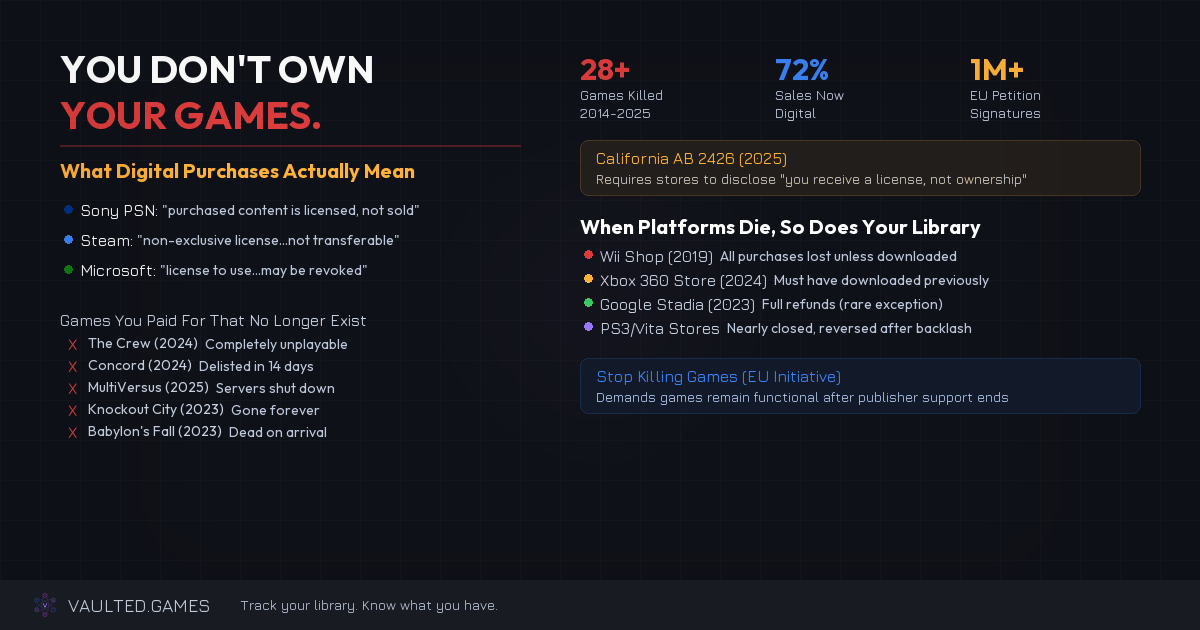
Go read Sony's Terms of Service. Buried in the legal language is this gem: "purchased content...is licensed, not sold." Steam's Subscriber Agreement says almost the same thing, describing your access as a "non-exclusive license...not transferable." Microsoft and Nintendo use similar language. Every single one of them.
What this means in plain English: when you click "Buy" on the PlayStation Store, Steam, Xbox Store, or Nintendo eShop, you're purchasing permission to access that game. The publisher or platform can revoke that permission. You can't resell it, you can't transfer it to someone else, and if the servers go down or the game gets delisted, tough shit.
Compare that to a physical disc. You buy a Blu-ray copy of a game, you own that disc. You can sell it on eBay, lend it to a friend, play it offline 20 years from now. The publisher can't show up at your house and take it back. That distinction matters, and it's getting more important every year as physical games become harder to find. 72% of all game sales were digital in 2024. The industry is moving toward a model where you own nothing.
Games That Have Already Disappeared
This isn't theoretical. Games have been ripped away from paying customers, and it's happening more frequently.
The Crew is the landmark case. Ubisoft shut it down in March 2024, making the game completely unplayable, including single-player content. People who paid $60 for this game got nothing. No refund, no offline mode, nothing. It just stopped working. And they're doing it again with The Crew 2, scheduled for shutdown in March 2025.
Then there's Concord, Sony's hero shooter that got delisted just 14 days after launch in September 2024. Two weeks. People bought it at full price and couldn't play it anymore. MultiVersus followed in May 2025. Knockout City, Babylon's Fall, Rumbleverse, CrossfireX, all shut down in 2023. The list keeps growing, with 28+ live service games confirmed dead between 2014 and 2025.
And it's not just individual games. Entire storefronts have closed. Nintendo's Wii Shop Channel shut down in January 2019, and every purchase was lost unless you'd already downloaded it to your console. The Xbox 360 Marketplace closed in July 2024. Sony nearly pulled the plug on the PS3 and Vita stores in 2021 before massive community backlash forced them to reverse course. The one bright spot? Google Stadia shut down in January 2023 but actually issued full refunds for all game and hardware purchases. That's the exception, not the rule.
The Fight for Your Rights
Gamers are starting to push back, and some of it is actually working.
California's AB 2426, which takes effect in 2025, requires digital storefronts to clearly disclose that you're receiving a license, not ownership, when you "buy" a digital product. It's a small step, but it forces companies to stop hiding behind misleading "Buy" buttons. If you're buying a license, the store has to say so.
The bigger movement is Stop Killing Games, an initiative started by YouTuber Ross Scott. It's an EU Citizens' Initiative that has collected over 1 million signatures demanding that game publishers be required to keep games functional even after they stop officially supporting them. The EU is now legally required to formally respond to the initiative. It's not a law yet, but it's the most organized consumer push for game preservation we've ever seen.
These efforts matter because they're attacking the core problem: publishers treat games as disposable products while charging permanent-purchase prices. You pay $70 and get something that can vanish whenever the publisher decides the servers aren't worth running anymore. That math doesn't work for consumers.
What You Can Actually Do About It
You can't fix the entire system on your own, but you can make smarter choices about how you spend your money.
GOG (Good Old Games) is the gold standard for actual digital ownership. Every game on GOG is DRM-free, meaning you download the full installer file and keep it forever. No online check-ins, no server dependencies, no license that can be revoked. GOG has over 6,000 games in their catalog, and once you download one, it's yours in every meaningful sense of the word. It's the closest thing to physical ownership in the digital space.
Physical copies still matter for console gamers. Yes, many modern discs require day-one patches, but you still own the base game on that disc. You can resell it, trade it, or play it offline years from now. For games you really care about preserving, physical is still the safest bet.
Be skeptical of live service games. If a game requires always-online servers to function and has no single-player offline component, you're essentially renting it. That doesn't mean don't play them, just go in with your eyes open. A $70 live service game with a two-year lifespan has a very different value proposition than a single-player RPG you can replay forever.
And track what you actually have. This sounds basic, but most gamers have libraries spread across 3, 4, 5 different platforms and honestly couldn't list every game they own. If a storefront announces it's shutting down or a publisher starts delisting titles, you want to know immediately what's at risk in your collection, not find out six months later when you try to play something and it's gone.
Why Tracking Your Library Matters More Than Ever
This is exactly the kind of problem Vaulted.Games was built to solve. When your "purchases" are really just licenses scattered across PlayStation, Xbox, Steam, Nintendo, and Game Pass, you need a single place to see everything you have and everything that's happening to it.
Vaulted.Games lets you track your entire library across platforms. So when the next game gets delisted or the next storefront closes, you'll know exactly what's in your collection and what might be at risk. And with price tracking and alerts built in, you can make sure you're at least paying a fair price for those licenses instead of getting blindsided by dynamic pricing experiments on top of everything else.
You might not be able to truly own your digital games. But you can at least keep track of what you're paying for, know when things are about to disappear, and make damn sure you're getting the best price possible for a license instead of ownership.