
How Long Should You Wait to Buy a New Game? A Price Drop Timeline
You just watched a trailer for a game that looks incredible. Your wallet says $70. Your brain says "it'll be on sale eventually." But when? Two weeks? Six months? Two years? And is the wait actually worth it?
We dug into years of pricing data from Steam, PlayStation, Xbox, Nintendo, and Epic Games Store to build an actual timeline of when games drop in price, how much they drop, and when you should just pull the trigger. No guessing, no vibes. Just the numbers.
How Fast Do Games Actually Drop in Price?
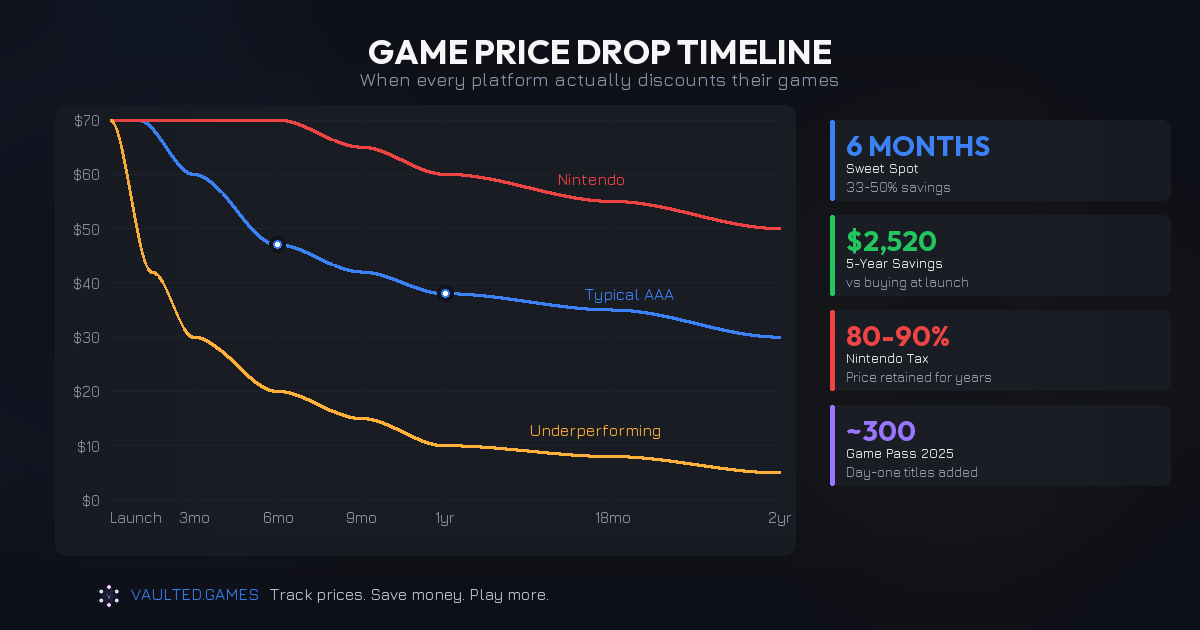
Short answer: Most non-Nintendo AAA games hit their first sale within 3-6 months and reach 50% off within 7 months on average.
That's the headline, but the reality is way more nuanced. Platform matters. Publisher matters. How well the game sells matters a lot. Here's what the data actually shows, pulled from PC Gamer's multi-year analysis of hundreds of Steam titles:
| Discount Tier | Average Wait | What You'd Pay on a $70 Game |
|---|---|---|
| First sale (10-20% off) | 2-3 months | $56-63 |
| 33% off | 4.5 months (median: 2 months) | ~$47 |
| 50% off | ~7 months | $35 |
| 75% off | ~15 months | $17.50 |
A few things stand out here. That median of 2 months for a 33% discount means half of all games hit that mark fast, but the average gets dragged up by holdouts like Nintendo first-party and mega-hits that don't need to discount. And Valve has rules: games can't be discounted for 30 days after launch, with a mandatory 28-day cooldown between sales. So the absolute earliest you'll see any discount on Steam is about a month out.
What About Games That Flop?
Games that underperform commercially drop in price 60% faster than bestsellers. This is panic pricing in action, and publishers aren't shy about it.
Look at some recent examples:
Star Wars Outlaws launched at $70 in August 2024 and was 40-50% off within six weeks. Suicide Squad: Kill the Justice League hit 50%+ off in two months. Dragon Age: The Veilguard saw 45% off by January after a November launch.
The pattern is clear: if reviews are mixed and sales are soft, publishers slash prices fast to recoup development costs through volume. Ironically, these steep discounts often signal games you might not want to buy at any price. But sometimes a decent game just gets buried by bad marketing or unfortunate timing. That's where a price tracker earns its keep.
How Does This Play Out on Each Platform?
Steam / PC
Steam is the most predictable platform for price drops, thanks to its locked-in seasonal sale calendar:
Spring Sale (mid-March), Summer Sale (late June), Autumn Sale (late November), Winter Sale (late December). On top of those, publishers run their own weekend sales constantly. Ubisoft, Capcom, and others frequently hit 80-90% off on older catalogs.
The best time to buy on PC is the Summer or Winter Sale. These two consistently offer the deepest discounts across the widest selection.
PlayStation
Sony runs sales constantly through the PS Store with themed events like "Essential Picks," "Big in Japan," and the big Days of Play mid-year sale. First-party exclusives follow a predictable pattern: physical copies drop to $30-40 within a year, and major titles hit PS Plus Extra at around 24-28 months.
God of War Ragnarok? Launched November 2022, joined PS Plus Extra in January 2025 (26 months). Spider-Man 2? October 2023 launch, PS Plus Extra in February 2026 (28 months).
So if you're a PS Plus Extra subscriber and you can wait about two years, Sony's biggest games eventually land in the catalog. That's a $15/month subscription covering games that cost $70 at launch.
One nice recent addition: the PlayStation Store now displays the lowest price from the last 30 days directly on game pages. No more guessing whether you're getting a real deal.
Xbox / Game Pass
Xbox flipped the whole model. Every Microsoft, Activision Blizzard, and Bethesda game launches day one on Game Pass Ultimate ($20/month). Call of Duty, Doom, Elder Scrolls, Forza, Halo... all of it, launch day, no extra cost.
In 2025 alone, Game Pass added nearly 300 games worth over $8,000 in retail value. Third-party day-one titles are increasing too (Clair Obscur: Expedition 33 was the biggest third-party day-one launch on the service in 2025).
If you're on Xbox and subscribe to Game Pass Ultimate, the "how long should I wait" question is mostly irrelevant for first-party games. You're playing them day one for the cost of your subscription.
Nintendo
Then there's Nintendo. The "Nintendo tax" is the bane of every patient gamer's existence, and the data backs it up completely.
Breath of the Wild stayed at $59.99 for over six years. Tears of the Kingdom launched at $69.99 and the best deal it's seen is $39.99 at Target, 19 months later. On the eShop? Never below $50. Super Smash Bros. Ultimate has hit $39.99 on its best day. Nintendo first-party games retain 80-90% of their launch value years after release.
Here's the realistic timeline for Nintendo:
| Discount Tier | Typical Wait | Notes |
|---|---|---|
| First sale (20-33% off) | 6-12+ months | And this is considered generous |
| 33% off | 1-2+ years | The "good deal" threshold for Nintendo |
| 50% off | Rare, if ever | Only select titles approaching end-of-life |
| Budget price ($20) | Almost never | First-party just doesn't go there |
And it's getting worse. First-party Switch 2 games are launching at $79.99. Mario Kart World is $80 digital. If the Nintendo tax was painful at $60, it's about to get brutal at $80.
Epic Games Store
Epic's model is unique because they literally give games away. One free game every week, with daily giveaways during the holiday season. These aren't bargain bin titles either.
Hogwarts Legacy went from $60 at launch in February 2023 to completely free on EGS in December 2025. That's the entire $60 game, free, in under three years.
If you're building a PC library on a budget, claiming every free Epic game should be a weekly habit. Even if you don't play them now, they're yours permanently.
Real Games, Real Price Drops
Theory is nice, but let's look at what actually happened with some of the biggest games from 2022-2024:
| Game | Launch Price | Time to 50% Off | Best Price Ever | The Wait |
|---|---|---|---|---|
| Elden Ring | $59.99 | ~18 months | $28.78 (Jul 2025) | 3.5 years |
| Hogwarts Legacy | $59.99 | 10 months | Free on EGS (Dec 2025) | 2.8 years |
| Baldur's Gate 3 | $59.99 | Never (max 25% off) | $44.69 (Dec 2025) | 2+ years, still holding |
| God of War Ragnarok | $69.99 | ~12 months (physical) | $24.99 / PS Plus Extra | 26 months to free via sub |
| Zelda: TOTK | $69.99 | Never on eShop | $39.99 Target (Dec 2024) | 19 months for ~43% off |
| Metaphor: ReFantazio | $69.99 | ~13 months | $21.81 (Jan 2026) | 15 months for 69% off |
The spread is massive. Hogwarts Legacy went from $60 to free. Baldur's Gate 3 has barely moved. Zelda is still expensive. And Metaphor, a great but not mega-selling JRPG, followed the textbook discount curve from $70 to $22 in just over a year.
The takeaway: game quality and sales performance predict price drops better than time alone. Mega-hits hold their value. Everything else follows the curve.
The Patient Gamer Math: How Much Can You Actually Save?
Let's put real numbers on it. Assume you buy 12 games per year (one a month, not unreasonable for someone who games regularly).
| Strategy | Avg Price Per Game | Annual Cost | Savings vs Day-One |
|---|---|---|---|
| Day-one buyer ($70 each) | $70 | $840 | -- |
| Mixed buyer (6 AAA + 6 indie) | $60 | $720 | $120 (14%) |
| 3-month wait | ~$50 | $600 | $240 (29%) |
| 6-month wait | ~$38 | $456 | $384 (46%) |
| 1-year wait | ~$28 | $336 | $504 (60%) |
| 2-year wait | ~$17 | $204 | $636 (76%) |
| GOTY editions only (~18 mo) | ~$20 | $240 | $600 (71%) |
| Game Pass / PS Plus Extra only | $17-20/mo | $204-240/yr | $600-636 (71-76%) |
Over five years, a patient gamer who waits one year saves roughly $2,520 compared to buying everything at launch. That's a new gaming PC. Or a PS5 Pro and a stack of games. Or, you know, a vacation.
The 6-month mark is the real sweet spot for most people. You're saving nearly half your money while still playing games within a reasonable timeframe. Reviews are out, patches have landed, and GOTY editions might already be available.
When You Shouldn't Wait
Patient gaming isn't always the right call. There are real scenarios where waiting costs you more than it saves:
Multiplayer games with a ticking clock. Concord launched in August 2024 and was delisted 14 days later. Star Wars: Hunters shut down servers within a year. MultiVersus? Delisted and closed. If a multiplayer game looks fun, the playerbase is at its peak right now, not in six months.
Live service FOMO. Battle passes, seasonal events, and limited-time content are designed to punish patient gamers. At $10 per season with 4 seasons a year, battle passes alone cost $40 annually, often more than the base game. You can't buy the Season 1 rewards in Season 5.
Spoiler-heavy games. Waiting a year on a narrative masterpiece means dodging spoilers across YouTube, Reddit, Twitter, Discord, and every podcast on earth. For story-driven games you're genuinely excited about, the cultural experience of playing at launch has value that doesn't show up on a spreadsheet.
Games at risk of disappearing. 28 live service games from 2014-2025 have been confirmed dead. Delisted, servers off, unplayable. If a game is online-only and you want to experience it, waiting too long means you might not get to play it at all.
The Smart Strategy: A Tiered Approach
Instead of one rigid rule, build a buying strategy with tiers:
Buy day one when a game checks these boxes: it's a franchise you love, reviews are strong, it has online multiplayer you want to experience at peak, or spoiler risk is high. Budget 2-3 of these per year at $70 each.
Wait 3-6 months for games you're interested in but not desperate to play. You'll catch the first meaningful sale, reviews will have settled, and major bugs will be patched. This should be your default for most single-player AAA titles.
Wait 12+ months for your "eventually" list. Games you'll get to someday. At a year out, you're looking at 50-60% off, GOTY editions with all DLC included, and a fully patched experience. This is patient gaming at its best.
Let subscriptions do the work for everything else. Between Game Pass, PS Plus Extra, and Epic's free games, hundreds of titles flow through these services every year. Set up your watchlist and let the deals come to you.
How to Actually Track All of This
Manually checking five different stores every week isn't realistic. Here's what works:
Set price alerts. Tools like IsThereAnyDeal (PC), Deku Deals (Nintendo), and PSPrices (PlayStation) let you set a target price and get notified when it hits. Vaulted.Games tracks prices across all platforms in one place, alongside your wishlist and backlog, so you can see exactly when your target price gets hit without checking six different apps.
Claim every free Epic game. Even if you won't play it this month (or this year), claim it. It costs nothing and takes 30 seconds. Some of these are $60 games that became free.
Watch the seasonal calendar. Steam's Summer and Winter sales are the two biggest discount events on PC. PlayStation's Days of Play hits mid-year. Black Friday is platform-agnostic gold. Mark these on your actual calendar and do your bulk buying during these windows.
The Bottom Line
The data is pretty clear. For most games on most platforms, the 6-month mark is where patience really starts paying off, cutting your costs nearly in half. A full year gets you 50-60% savings and a better game (patched, reviewed, possibly bundled with DLC). And if you can wait two years or lean on subscriptions, you're looking at 70-80% savings.
The big exceptions are Nintendo (double all wait times, halve all savings), mega-hits that hold their value (Baldur's Gate 3, Elden Ring), and multiplayer games where the community won't wait for you.
Set your price alerts, know your tiers, and stop paying launch tax on games you won't play for months anyway.