

The Hidden Cost of Free-to-Play Games
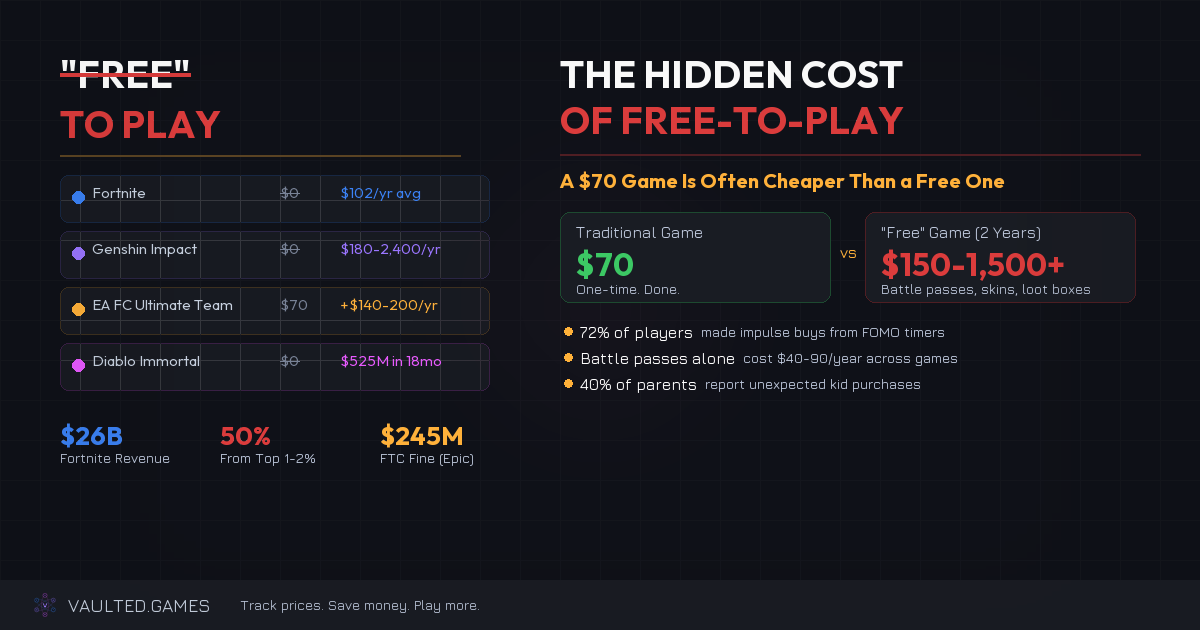
You've never paid a dime for that game on your phone. Or for Fortnite. Or Genshin Impact. It's free, right there in the name. Free-to-play. Except Fortnite has generated $26 billion in lifetime revenue, and the players writing those checks aren't some mythical group of strangers. A lot of them are you. The average Fortnite player spends about $102 per year on V-Bucks alone, and that's just one game.
The entire free-to-play model is built on a simple bet: give the game away, then make the money back (and then some) on microtransactions, battle passes, loot boxes, and cosmetics. And the bet keeps paying off. Honor of Kings sits at $14.1 billion in lifetime revenue, making it the highest-grossing F2P title ever. Genshin Impact crossed $5 billion in just three years. These aren't niche numbers. This is one of the most profitable business models in entertainment history.
So let's talk about what "free" actually costs.
The Battle Pass Treadmill
Battle passes seem cheap in isolation. Most run between $8 and $15 per season, and you get a bunch of cosmetics, maybe some in-game currency, and the feeling that you're getting value for your money. But games don't run one season per year. They run four to six, sometimes more.
Do the math on that. If you're playing two or three F2P games with battle passes, you're looking at $40-90 per year per game just on passes. Two games? That's potentially $180/year. Three? You're pushing $270. And that's before you buy a single extra skin, a single loot box, or top off your in-game currency because you were 50 coins short of something.
The pass also creates a psychological obligation. You paid for it, so now you feel like you need to play enough to unlock everything before the season ends. Miss a few weeks and suddenly you're grinding like it's a second job, or worse, buying tier skips to catch up. The battle pass didn't save you money. It bought your time and then sold it back to you.
Who's Actually Paying for All This
Here's a stat that should make you uncomfortable: the top 1-2% of spenders generate roughly 50% of all F2P revenue. The industry calls these players "whales," and the spending numbers are genuinely staggering.
Genshin Impact whales regularly spend $500 to $2,000+ per month chasing characters through the gacha system. One Diablo Immortal player reportedly dropped over $150,000 on the game. That's not a typo. One hundred fifty thousand dollars on a mobile game that pulled in $525 million in its first 18 months. And Diablo Immortal isn't even close to the top of the F2P revenue charts.
But here's what matters for the rest of us: even if you're not a whale, you're probably spending more than you think. The "average" player category is misleading because it includes people who genuinely never spend. Among players who do spend, the numbers climb fast. An engaged F2P player over two years typically racks up $150 to $400 in microtransactions. A whale over that same period? $5,000 to $50,000+.
Compare that to traditional gaming. A $70 AAA title is a one-time purchase. You own it, you play it, you're done. An engaged F2P player can easily blow $500 to $1,500 over two years on a game that was supposed to be free.
The Psychology Machine
F2P games don't accidentally separate you from your money. They're engineered to do it, and the tactics are borrowed straight from casino design and behavioral psychology.
Virtual currency obfuscation is the big one. You don't buy a $20 skin. You buy 2,000 V-Bucks for $15.99, then realize the skin costs 2,200 V-Bucks, so you need to buy another bundle. Now you've spent $31.98 and have leftover currency that's just enough to be annoying but not enough to buy anything good. The whole point of virtual currency is to disconnect you from real dollar amounts. It works.
FOMO and countdown timers are everywhere. Limited-time offers, rotating shops, seasonal exclusives. A 2023 survey found that 72% of F2P players admitted to making impulse purchases because of countdown timers. The game tells you this skin disappears in 23 hours and your brain shifts from "do I want this?" to "I'll miss out if I don't." That's not a coincidence, that's a design choice.
Loot boxes are gambling with extra steps. You pay real money for a random chance at what you want. The global loot box market hit $15 billion in 2024. Belgium straight up banned loot boxes in 2018 after classifying them as gambling. The Netherlands tried to follow. And the FTC hit Epic Games with a $245 million fine in 2022 for using dark patterns that specifically targeted children. These aren't conspiracy theories. These are regulatory actions by governments that looked at the data and said "yeah, this is predatory."
Artificial scarcity, daily login rewards, loss aversion mechanics. It's all designed to keep you coming back and keep your wallet open. And it's really, really good at its job.
The Spending By Game
Let's put some real names on this. Here's what the biggest F2P games are pulling in:
Fortnite generated $26 billion in lifetime revenue. The average spending player drops about $102/year on V-Bucks. That's almost $9/month on a "free" game, and most players have been at it for years now.
Genshin Impact crossed $5 billion in three years. The gacha system is the engine here. Want a specific five-star character? You might hit pity at 90 pulls, and each pull costs roughly $2-3 worth of premium currency. Whales pulling for constellations and weapons can easily spend $500+ on a single banner.
EA FC Ultimate Team (formerly FIFA) pulls in roughly $1.6 billion per year just from Ultimate Team mode. The average FUT player spends $140-200 annually on packs. And EA FC isn't even free-to-play. You already paid $70 for the game.
Diablo Immortal hit $525 million in 18 months despite being one of the most critically panned monetization systems in gaming history. Remember that $150,000+ player? They publicly stated the game was "unplayable" at their gear level because matchmaking couldn't find opponents.
Kids and the Credit Card
This one gets ugly. About 40% of parents report unexpected charges from their children's gaming. Kids don't understand the value of money the same way adults do, and F2P games are specifically designed to blur the line between playing and paying.
The $245 million FTC fine against Epic wasn't random. It targeted practices like one-click purchasing with no confirmation screen, making it trivially easy for a kid to spend real money without realizing it. And that's just one company that got caught.
If you've got kids playing F2P games, parental controls and purchase approvals aren't optional, they're a requirement. Every platform has them. Xbox, PlayStation, Nintendo, iOS, Android, Steam. Set them up. Seriously. A few minutes of setup can save you from a surprise $500 credit card bill from your eight-year-old's Roblox habit.
The Math That Should Piss You Off
Let's lay it out plainly.
A traditional AAA game costs $70 once. You play it for 40-100+ hours. That's roughly $0.70-1.75 per hour of entertainment. It's one of the best value propositions in entertainment, cheaper per hour than movies, concerts, even most streaming services.
A "free" game where you're an engaged player costs $500 to $1,500 over two years. Maybe more. And a huge chunk of that goes toward cosmetics that have zero resale value and will disappear when the servers shut down. You don't own any of it.
So the next time you catch yourself thinking "at least it's free," ask yourself what the actual tab looks like. Pull up your purchase history. Check your bank statements for those $4.99 and $9.99 charges. Add it up. The number almost always surprises people, and rarely in a good way.
How to Track What You're Actually Spending
The first step is visibility. You can't fix what you can't see. Here are a few practical moves:
Check your platform purchase histories. Steam has a total spend calculator. PlayStation, Xbox, and Nintendo all have transaction histories in account settings. Mobile? Check your App Store or Google Play purchase history. Most people haven't looked at these in years, if ever.
Search your email. Every microtransaction generates a receipt. Search your inbox for "Epic Games," "miHoYo," "Supercell," or whatever studios you've been spending in. The results can be illuminating.
Set a monthly gaming budget. Decide on a number you're comfortable with and stick to it. Remove saved payment methods from F2P games so every purchase requires a deliberate action, not just a tap.
Consider what that money could buy instead. If you're dropping $30/month across various F2P games, that's $360/year. That's five full AAA games at launch, or a dozen on sale. Vaulted.Games tracks prices across PlayStation, Xbox, Nintendo, and Steam so you can find legitimate deals on games you'll actually own. The irony of F2P is that buying games outright is often cheaper in the long run.
Regulators Are Starting to Notice
The regulatory landscape around F2P monetization is shifting, slowly. Belgium banned loot boxes in 2018. The FTC hit Epic with that $245 million fine. Multiple countries are exploring legislation around predatory monetization, especially when it comes to kids.
But regulation moves at government speed, which means it's years behind the industry. New monetization techniques pop up faster than lawmakers can study them. Right now, the best protection is your own awareness. Know the tricks. Track your spending. And don't let a "free" game quietly drain more money than your entire gaming library would cost if you just bought the damn games.
The free-to-play model isn't going anywhere. It makes too much money. But you don't have to be the one funding it. Set your limits, watch your spending, and remember that a $70 game with no microtransactions is often the cheapest option on the table.