

Steam vs Console: Where Are Games Actually Cheapest in 2026?
Everybody has an opinion about which platform has the best game prices. Steam fans say PC is always cheaper. Console players point to Game Pass or PS Plus. Nintendo fans just try not to think about it.
But what do the actual numbers say? We pulled real pricing data across Steam, PlayStation Store, Xbox Store, and the Nintendo eShop to figure out where your dollar goes the furthest. The results aren't surprising if you've been paying attention, but the gap is bigger than most people realize.
Quick Answer: Which Platform Has the Cheapest Games?
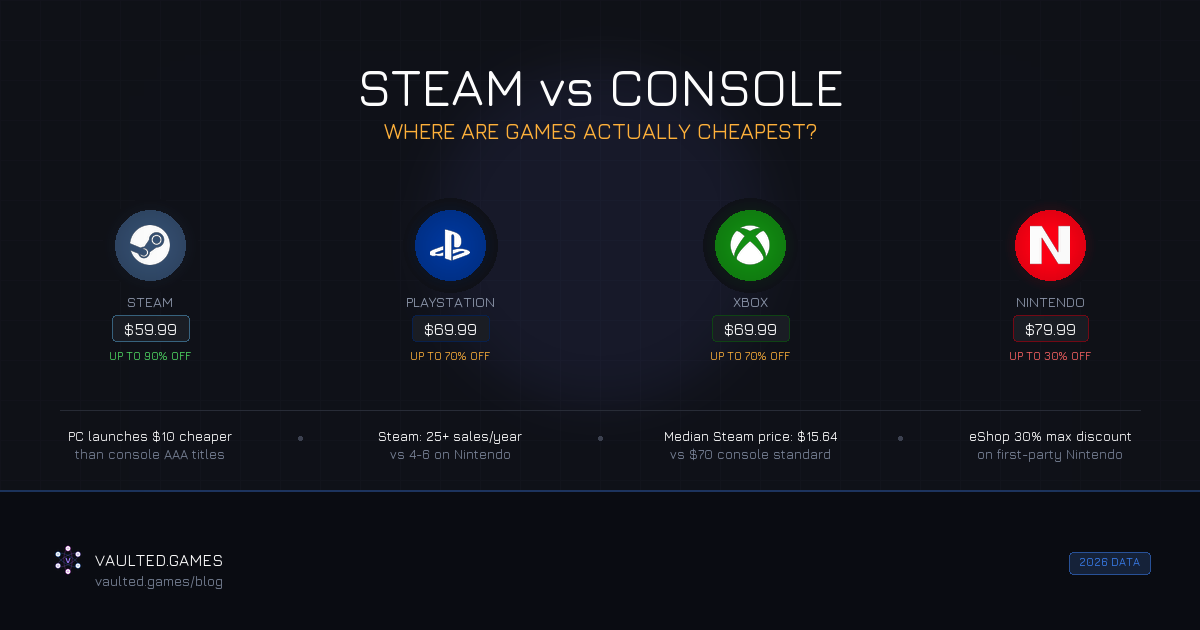
Steam (PC) wins by a wide margin for overall game pricing. The median price for top new releases on Steam dropped to roughly $15.64 in late 2025, while console storefronts held firm at $69.99 for AAA launches. Steam runs more sales, offers deeper discounts, and benefits from competition with Epic Games Store, GOG, Humble Bundle, and Fanatical.
But that's not the full picture. Subscriptions like Game Pass and PS Plus change the math entirely if you're playing enough games. And Nintendo? Well, Nintendo does its own thing (and charges accordingly).
Here's the full breakdown.
The Base Price Gap: PC vs Console
The $70 standard that took hold on PS5 and Xbox Series X hasn't fully migrated to PC. Many publishers still launch PC versions at $59.99, a full $10 less than the console equivalent.
Real examples of launch day price differences:
| Game | Steam (PC) | PS5 | Xbox Series X | Switch/Switch 2 |
|---|---|---|---|---|
| Kingdom Come: Deliverance II | $59.99 | $69.99 | $69.99 | N/A |
| Hogwarts Legacy | $59.99 | $69.99 | $69.99 | $59.99 |
| Final Fantasy VII Rebirth | $49.99 | $69.99 | N/A | N/A |
| Star Wars Outlaws | $59.99 | $69.99 | $69.99 | N/A |
| Mario Kart World | N/A | N/A | N/A | $79.99 |
| Elden Ring | $59.99 | $59.99 | $59.99 | N/A |
| Metaphor: ReFantazio | $59.99 | $69.99 | $69.99 | N/A |
| Call of Duty: Black Ops 6 | $69.99 | $69.99 | $69.99 | N/A |
A few things jump out here. Most third-party AAA titles launch $10 cheaper on Steam than on PS5 or Xbox. Some publishers (like Activision with Call of Duty) charge $70 across the board. And Nintendo just said "screw it" and went to $80 with Mario Kart World, becoming the first major publisher to break past $70.
The Elden Ring line is interesting because FromSoftware kept it at $60 everywhere, bucking the trend. But they're the exception, not the rule.
Sale Prices: Where the Real Savings Happen
Launch prices matter, but most smart gamers don't buy at launch. Sales are where the actual value shows up, and the platforms aren't even playing the same game here.
Steam Sales
Steam runs 5 major seasonal sales and roughly 21 smaller themed sales per year. That's a sale happening almost every other week. Average discounts during major events sit around 40%, but older titles routinely hit 75-90% off.
Steam's biggest advantage isn't just frequency, it's competition. Epic Games Store, GOG, Humble Bundle, Fanatical, and Green Man Gaming all compete for the same PC audience. That competition drives prices down across the board. A game that's $30 on Steam might be $25 on Fanatical with a coupon, or $22 on a Humble Bundle.
Plus, Epic gives away free games every single week. In 2023 alone, EGS gave away over $2,000 worth of games for free. That's continued through 2025 with titles worth $60+ being given away in a single month.
PlayStation Store Sales
Sony runs several major sales per year: Days of Play (late May/early June), Black Friday, holiday sales, and various flash sales throughout the year. Discounts typically cap around 50% for newer titles during major events, with older titles hitting deeper cuts.
During Days of Play 2025, discounts ranged from 17% off on newer titles like Astro Bot to 45% off on games like Call of Duty: Black Ops 6. Those aren't bad, but they aren't Steam-level.
PSN's weakness: Games hold their full price longer. You'll rarely see a meaningful discount in the first 2-3 months after launch. Steam frequently has publisher sales or weekend deals within weeks of release.
Xbox Store Sales
Xbox runs a similar cadence to PlayStation with Black Friday sales (2,000+ titles discounted in 2025), a Countdown Sale in December, and regular weekly Deals with Gold. Discount depths are comparable to PSN, typically 30-60% during major events.
Xbox's ace in the hole is Game Pass, not individual game sales. But if you're buying games outright on the Xbox Store, you're generally paying similar prices to PSN.
Nintendo eShop Sales
And then there's Nintendo.
First-party Nintendo games max out at roughly 30% off during the best sales. That's as good as it gets. The Legend of Zelda: Tears of the Kingdom launched at $70 and you'd be lucky to catch it at $42-49 during a holiday sale. Meanwhile, similar-aged games on Steam would be 50-70% off.
Third-party games are almost universally more expensive on the eShop than on Steam. Every single game on the Switch's best sellers list is priced higher than its Steam equivalent. The "Nintendo Tax" isn't just about first-party titles, it's the entire ecosystem.
Nintendo's saving grace? Physical copies of Nintendo games hold their resale value better than any other platform. But we covered that in our physical vs digital breakdown.
Historical Low Prices: The Same Games, Wildly Different Deals
Here's where the data gets really interesting. We compared the all-time lowest prices for popular games across platforms using price tracking data from PSPrices, Deku Deals, SteamDB, and IsThereAnyDeal.
| Game | Steam Low | PSN Low | Xbox Low | eShop Low |
|---|---|---|---|---|
| Elden Ring | $17.99 | $19.99 | $15.00 | N/A |
| Hogwarts Legacy | $17.99 | $19.99 | $13.99 | $29.99 |
| Red Dead Redemption 2 | $14.99 | $14.99 | $14.99 | N/A |
| Baldur's Gate 3 | $35.99 | $41.99 | $41.99 | N/A |
| The Witcher 3: Wild Hunt | $5.99 | $7.99 | $7.99 | $19.99 |
| Cyberpunk 2077 | $14.99 | $24.99 | $24.99 | N/A |
| Zelda: Tears of the Kingdom | N/A | N/A | N/A | $41.99 |
| It Takes Two | $9.99 | $9.99 | $9.99 | $19.99 |
| Hades | $6.24 | $9.99 | $9.99 | $12.49 |
| Stardew Valley | $7.49 | $10.49 | $10.49 | $10.49 |
A few patterns worth noting. Steam consistently hits the lowest or ties for lowest price on multi-platform games. Xbox occasionally undercuts everyone on specific titles (Hogwarts Legacy at $13.99 is a standout). PSN and Xbox tend to land in the same ballpark. And the eShop is almost always the most expensive option, even on third-party indie games like Hades or The Witcher 3.
The Witcher 3 is a great example. A game that's been out since 2015 hit $5.99 on Steam but still costs $19.99 at its lowest on the eShop. That's a 233% markup for the same game running on weaker hardware.
The Subscription Factor
Comparing individual game prices without mentioning subscriptions would be leaving out the biggest wildcard. Here's where things stand in early 2026:
Game Pass Ultimate costs $29.99/month after Microsoft's 50% price hike in October 2025. That's $360/year. You get day-one access to all Microsoft first-party games, a rotating library of 300+ titles, EA Play, Ubisoft+ Classics, and cloud gaming. If you play 3+ Game Pass games per month, the per-game value is hard to beat. But $30/month is steep, and the library rotates, meaning games leave.
PS Plus Extra runs $14.99/month ($134.99/year). You get a catalog of 400+ PS4/PS5 games plus Ubisoft+ Classics. No day-one first-party access, but the catalog includes heavy hitters added 6-12 months after launch. At roughly half the price of Game Pass Ultimate, it's the better value if you don't need day-one access.
Nintendo Switch Online + Expansion Pack costs $49.99/year. You get NES, SNES, N64, Game Boy, and other retro catalogs. No modern game library. It's not comparable to Game Pass or PS Plus as a money-saving subscription. It's more of a nostalgia add-on.
If you factor subscriptions into the cost-per-game equation, Xbox and PlayStation close the gap with Steam significantly. A Game Pass subscriber playing 5 games/month is paying roughly $6 per game. That's competitive with Steam sale prices. But you're paying that monthly fee whether you play 5 games or zero.
Regional Pricing: Steam's Hidden Advantage
Here's something console players rarely think about. Steam uses regional pricing based on purchasing power parity. A game that costs $60 in the US might cost $15-30 in countries like Brazil, India, Turkey, or Argentina. Publishers set these prices using Valve's recommended pricing matrix, making gaming significantly more accessible worldwide.
Console stores technically have regional pricing too, but the discounts are typically smaller, and Sony and Microsoft have been criticized for using outdated currency data that leaves players in some regions paying more than they should relative to local economies.
This matters even for US-based gamers because it shows Steam's commitment to keeping games affordable. Valve actively encourages publishers to price games reasonably, and the competitive storefront ecosystem keeps everyone honest.
Refund Policies: Your Safety Net
When you're spending money on games, knowing you can get that money back if something sucks matters.
Steam offers the best refund policy in gaming: full refund within 14 days of purchase if you've played less than 2 hours. No questions asked, automated process.
Xbox matches Steam's terms on paper: 14 days, under 2 hours of play. The process is straightforward through your Microsoft account.
PlayStation allows refunds within 14 days, but here's the catch: you can't have downloaded the game. Once it's on your console, Sony considers it used. That's significantly worse than Steam or Xbox.
Nintendo barely has a refund policy at all. Digital purchases on the eShop are essentially final. No grace period, no playtime threshold. Buy the wrong game? Tough luck.
If you're someone who tries games and returns them when they don't click, Steam is the only platform where that's genuinely friction-free.
The "Free Games" Factor
One area where PC dominates that doesn't get enough attention: free games.
Epic Games Store gives away free games every single week. These aren't shovelware. We're talking games like GTA V, Civilization VI, Death Stranding, and dozens of other AAA and indie titles. Over the years, EGS has given away thousands of dollars worth of games per user.
Amazon Prime Gaming (included with Amazon Prime) offers 5-8 free games per month plus in-game loot.
Humble Bundle occasionally offers free games, and their monthly Choice subscription ($11.99/month) typically includes 5-8 games worth $100+.
Console platforms don't have anything that competes with this. PS Plus Essential includes 2-3 monthly games, but you need an active subscription to access them and they're "included" rather than "free." Xbox's Games with Gold was gutted years ago.
Where Each Platform Wins (and Loses)
Steam/PC wins on: base prices, sale frequency, sale depth, free games, refund policy, regional pricing, third-party competition, and overall library cost. For pure value per dollar spent on games, PC is the cheapest platform and it's not particularly close.
PlayStation wins on: exclusive titles you can't get elsewhere (Spider-Man, God of War, The Last of Us), PS Plus Extra value relative to its price, and a solid physical game market with good resale value.
Xbox wins on: Game Pass day-one releases (if you value that), backward compatibility with older titles, and occasional aggressive pricing on individual titles. Xbox also has the most consumer-friendly refund policy of the console platforms.
Nintendo wins on: nothing price-related, honestly. Nintendo games cost more at launch, go on sale less often, discount less when they do, and have the worst refund policy in the industry. But you can't play Mario, Zelda, or Pokemon anywhere else, and Nintendo knows it. The premium is for the exclusive content, not for value.
How to Always Get the Best Price (Regardless of Platform)
Knowing which platform is cheapest overall is useful, but here's how to actually put it into practice.
Use price tracking tools. Vaulted.Games tracks prices across every major platform so you can compare before you buy. Set alerts at your target price and wait for the notification instead of impulse buying. Other solid tools include IsThereAnyDeal (PC focused), Deku Deals (Nintendo), and PSPrices (PlayStation/Xbox).
Buy multi-platform games on PC when possible. If a game is available on both your console and Steam, check the PC price first. It's frequently $10 cheaper at launch and drops faster on sale.
Use subscriptions strategically. Don't pay for Game Pass year-round if you're only playing 2-3 games from it. Subscribe for a month or two when there's a cluster of games you want, then cancel. Same goes for PS Plus Extra.
Stack discounts. On PC, combine store sales with coupon codes, cashback programs, and bundle deals. Sites like GG.deals and IsThereAnyDeal aggregate the lowest prices across dozens of authorized retailers.
Wait 3-6 months. This applies everywhere but hits especially hard on PlayStation and Xbox. A $70 console game will be $35-45 within 6 months. On Steam, it could be $20-30 in the same timeframe.
The Bottom Line
| Platform | Avg Launch Price (AAA) | Best Sale Depth | Sale Frequency | Subscription Value | Refund Policy |
|---|---|---|---|---|---|
| Steam (PC) | $59.99 | Up to 90% off | 25+ sales/year | N/A (free games via EGS) | Best (14 days/2 hrs) |
| PlayStation | $69.99 | Up to 70% off | 8-10 sales/year | PS Plus Extra: $135/yr | Poor (no download) |
| Xbox | $69.99 | Up to 70% off | 8-10 sales/year | Game Pass: $360/yr | Good (14 days/2 hrs) |
| Nintendo | $59.99-79.99 | Up to 30% off (1st party) | 4-6 sales/year | NSO: $50/yr (retro only) | Worst (no refunds) |
PC gaming is the cheapest way to buy games in 2026 if you're willing to wait for sales. Console gamers can close the gap with smart subscription use, but they're paying a premium for the convenience and exclusives. And Nintendo is just expensive. Full stop.
If you're tired of overpaying, start tracking prices across platforms. Vaulted.Games makes that easy by monitoring deals everywhere, so you always know whether Steam, PlayStation, Xbox, or the eShop has the best price for the game you want.
Sources: SteamDB, PSPrices, Deku Deals, IsThereAnyDeal, GG.deals, Outlook Respawn - PC Game Prices, Kotaku - Mario Kart World $80, Game Informer - Game Pass Price Hike