

Physical vs Digital Games: Which Is Actually Cheaper?
The "physical vs digital" debate has been going on for years. Most people pick a side based on vibes. Shelf full of game cases looks cool. Digital library is convenient.
But if your goal is spending less money on games, the answer isn't as simple as picking one or the other. Sometimes physical saves you money. Sometimes digital does. And sometimes the difference is so small it doesn't matter.
Here's the actual breakdown, with real numbers.
Quick Answer: Is It Cheaper to Buy Physical or Digital Games?
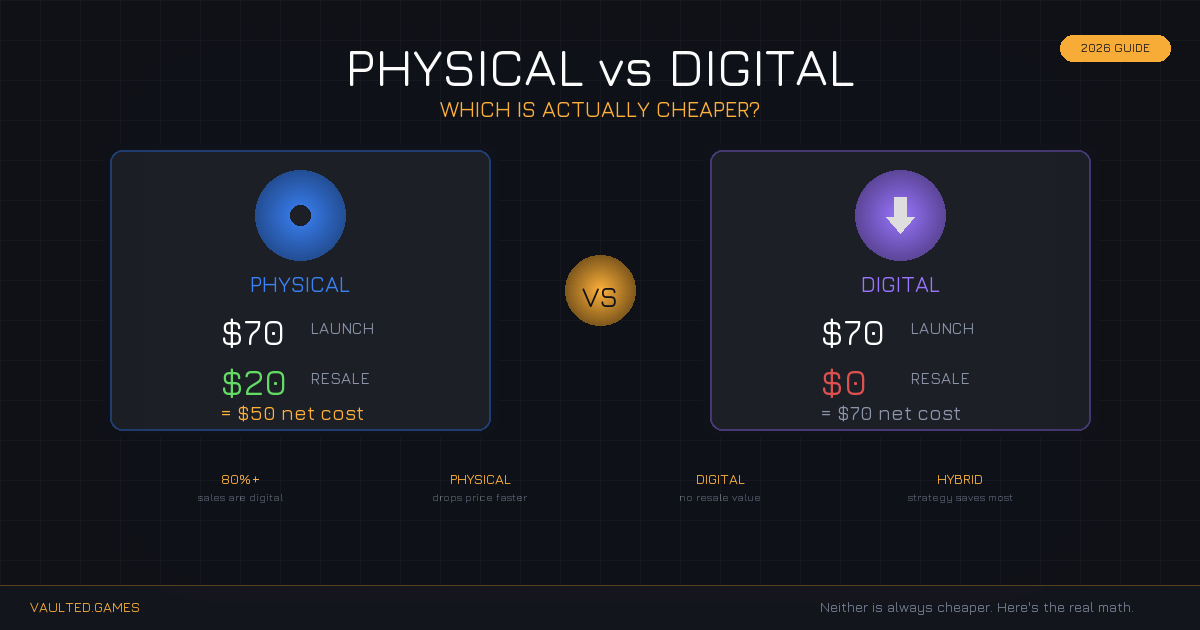
It depends on your habits. If you finish games and resell them, physical is almost always cheaper. A $70 game that you resell for $40 after a month costs you $30 net. No digital purchase beats that.
If you never resell, digital wins over time because digital sales are more frequent and go deeper. Steam, PlayStation Store, and Xbox sales regularly hit 50-75% off, while physical copies at retail rarely match those discounts on newer titles.
The short version:
- Resell your games? Buy physical.
- Hold everything forever? Buy digital on sale.
- Play on PC? Digital only (physical PC games are basically dead).
The Price Comparison Nobody Talks About
At launch, physical and digital games cost the same: $69.99 for most AAA titles across PS5 and Xbox Series X. But what happens after launch is where the real difference shows up.
Physical Price Drops
Physical games drop in price faster than digital, especially in the first 6-12 months:
| Time After Launch | New Physical | Used Physical | Digital (PSN/Xbox Store) |
|---|---|---|---|
| Launch day | $69.99 | N/A | $69.99 |
| 1 month | $59.99 | $45-55 | $69.99 |
| 3 months | $49.99 | $30-40 | $55.99 (20% sale) |
| 6 months | $39.99 | $20-30 | $34.99 (50% sale) |
| 12 months | $29.99 | $15-20 | $17.49 (75% sale) |
| 18+ months | $19.99 | $10-15 | $13.99 (80% sale) |
Physical new copies drop faster because retailers need to clear shelf space. Best Buy, Walmart, and Amazon regularly discount games within weeks of launch. Used copies from GameStop, eBay, or Facebook Marketplace go even lower.
Digital games hold their price longer. PSN and the Xbox Store rarely discount games in the first month. But when digital sales do hit, they can go deeper than physical, especially during major sale events.
The Resale Factor (Physical's Biggest Advantage)
This is where physical pulls ahead, and it's not close.
Physical game cost equation:
Purchase Price - Resale Value = Actual Cost
If you buy a game for $70 and sell it for $40 a month later, you paid $30 to play that game. You can't do that with digital.
Average resale values (sold within 30 days of purchase):
| Game Type | Resale Value | Net Cost (from $70 purchase) |
|---|---|---|
| AAA launch title | $40-50 | $20-30 |
| Popular multiplayer | $35-45 | $25-35 |
| Single-player (completed) | $30-40 | $30-40 |
| Niche/indie (physical) | $20-30 | $40-50 |
Where to resell:
- Facebook Marketplace/OfferUp: Best prices, but requires meetups or shipping
- eBay: Wider audience, but 13% in fees
- GameStop trade-in: Lowest value, but instant and easy
- r/GameSale: Reddit marketplace, solid prices, lower fees
If you're someone who plays a game, finishes it, and moves on, physical is the cheapest way to game. Period. You're essentially renting games for $20-30 each.
When Digital Wins
Physical has the resale advantage, but digital has its own strengths.
1. Sale Prices Go Deeper
During major sales (Steam runs 30+ sale events per year, PlayStation Days of Play, Xbox holiday sales), digital prices crater. A game that's $29.99 physical at Best Buy might be $14.99 on the PlayStation Store during a flash sale.
PC is entirely digital territory. Steam, Epic, GOG, Humble Bundle, and Fanatical compete aggressively on pricing. It's common to see AAA games at 80-90% off within 18 months on PC storefronts. Physical PC games basically don't exist anymore.
2. No Shipping or Travel Costs
Buying physical means either paying for shipping or driving to a store. Digital is instant. If you're impulse-buying a game at 2 AM, the convenience tax is zero.
3. Game Pass and PS Plus
Subscription services are all digital. If you're already paying for Game Pass or PS Plus Extra, you have access to hundreds of games without buying anything. The "physical vs digital" debate becomes irrelevant for anything in the catalog.
4. Storage and Convenience
No disc swapping. No shelf space. No risk of losing or scratching discs. Your entire library is accessible from the console menu.
The tradeoff? You need hard drive space regardless. Even physical disc games require full installs on PS5 and Xbox Series X. The disc is just an authentication key. A 1TB SSD fills up fast when games are 50-150GB each.
Why Are Digital Games More Expensive?
This is one of the most common complaints in gaming, and honestly, it's a fair question. Digital games have no manufacturing costs, no shipping, no retail shelf space, no physical materials. So why do they cost the same $70 as a disc in a plastic case?
Platform fees are the biggest factor. Sony, Microsoft, and Nintendo take a 30% cut of every digital sale on their storefronts. That's $21 on a $70 game. Publishers set prices knowing that cut is coming, and they have zero incentive to undercut physical retail because that would piss off their retail partners (Best Buy, Walmart, GameStop) who still move millions of units.
No retail competition. When you buy a physical game, Best Buy, Amazon, Walmart, and GameStop are all competing for your purchase. That competition drives prices down fast. Digital storefronts? PSN is the only place to buy PS5 digital games. Xbox Store is the only place for Xbox digital games. No competition means no pressure to lower prices. PC is the exception here, where Steam, Epic, GOG, Humble, and Fanatical all compete, which is why PC digital prices tend to be better.
Retailers would revolt. If Sony priced digital games at $50 while physical sat at $70, retailers would reduce shelf space for PlayStation products or stop stocking them entirely. Console manufacturers need retail stores for hardware sales and visibility, so they keep digital and physical prices matched at launch.
The result: digital games cost the same at launch, hold their price longer between sales, but eventually go deeper during major sale events. If you're patient, digital catches up and sometimes beats physical pricing. But in the first few months after launch, you're almost always paying more to go digital.
The Ownership Problem
Here's the uncomfortable truth about digital games: you don't own them. You own a license to access them.
That license can be revoked. It's happened:
- Games have been delisted from digital stores (P.T., Scott Pilgrim before its re-release, dozens of licensed games)
- Store shutdowns kill access (Wii Shop Channel, PS3/PSP/Vita stores nearly closed)
- Account bans can lock you out of your entire digital library
With physical games, you own the disc. Nobody can take it away. You can play it, lend it, sell it, or stick it on a shelf for 20 years and come back to it.
Does this matter for most people? Honestly, not really. The vast majority of games stay available digitally, and most gamers don't replay games from a decade ago. But if game preservation matters to you, or if you like the idea of actually owning what you pay for, physical is the only option that guarantees it.
Platform-Specific Breakdown
The physical vs digital math changes depending on where you play.
PlayStation 5
PS5 is the strongest platform for physical gaming. Disc-based PS5 games are widely available, the used market is healthy, and PS5 discs work in any PS5 with a disc drive.
Key consideration: The PS5 Digital Edition saves you $50-100 upfront on hardware but locks you into digital-only purchases forever. If you buy 5+ games per year, the physical savings from resale will offset that hardware cost within the first year.
Xbox Series X|S
Xbox supports physical discs on Series X but not Series S. Microsoft has been pushing Game Pass hard, which is entirely digital. The physical game market for Xbox is smaller than PlayStation's.
Key consideration: If you have Game Pass, the physical vs digital question matters less since hundreds of games are already accessible. Physical Xbox games also tend to have lower resale value than PlayStation equivalents.
Nintendo Switch / Switch 2
Nintendo games hold their value better than any other platform. A first-party Nintendo title bought at launch for $60 can often be resold for $40-50 even a year later. Mario, Zelda, and Pokemon games rarely drop below $40 new.
Switch 2: Nintendo's next console reportedly supports physical game cards. Given Nintendo's track record of rarely discounting first-party titles digitally, physical Switch 2 games will likely be the smarter buy for Nintendo exclusives.
PC
Digital wins by default. Physical PC games are functionally extinct. Even if you buy a physical PC game, it usually just contains a code for Steam or another launcher.
PC gamers benefit from the most competitive digital marketplace in gaming. Steam, Epic (with coupons), GOG (DRM-free), Humble Bundle, Fanatical, and Green Man Gaming all compete on price. The result? Deeper discounts, more frequent sales, and the best value per dollar of any platform.
The Hybrid Strategy (What Smart Gamers Do)
The smartest approach isn't picking a side. It's using both strategically.
Buy physical when:
- You plan to finish the game and resell it within 1-3 months
- It's a Nintendo first-party title (high resale value)
- You want to lend it to a friend
- You care about owning a permanent copy
- The physical version is cheaper than digital (common at launch and shortly after)
Buy digital when:
- It's on a deep sale (50%+ off)
- It's a game you'll replay for years (multiplayer, roguelikes, sandbox games)
- You're on PC (no physical option worth considering)
- It's included in a subscription service
- Convenience matters more than saving a few dollars
The math on a typical year:
| Strategy | Annual Game Spend | Games Played |
|---|---|---|
| All physical at launch | $420 (6 games x $70) | 6 |
| All digital at launch | $420 (6 games x $70) | 6 |
| Physical + resell | $180 (6 games x $70 - $50 avg resale) | 6 |
| Digital on sale only | $210 (6 games x $35 avg sale price) | 6 |
| Hybrid (best of both) | $150 (mix of resale + sales) | 6 |
The hybrid approach saves you $240-270/year compared to buying everything at launch. That's real money.
FAQ: Physical vs Digital Games
Are physical games going away?
Not yet, but the trend is clear. Over 80% of game sales are now digital. Sony, Microsoft, and Nintendo all still support physical media, but disc-less console options are becoming more common. Physical will likely become a niche/collector option within the next decade.
Do physical games install faster than digital?
Disc installs are generally faster than downloads since you're reading from a local disc instead of downloading 50-100GB over the internet. But both require the same total storage space on your console's drive.
Can I convert physical games to digital?
No. If you want a digital copy of a game you own physically, you have to buy it again. There's no trade-in or conversion program on any platform.
Is the PS5 Digital Edition worth it?
If you buy fewer than 3-4 games per year and rely mostly on PS Plus, yes. If you buy 5+ games per year, the disc version pays for itself through physical game savings and resale within the first year.
Why are Nintendo games so expensive?
Nintendo rarely discounts first-party titles. The "Nintendo Tax" means games like Mario and Zelda stay at or near full price for years. This actually makes physical Nintendo games a better buy since their high resale value means low net cost.
The Bottom Line
| If you... | Buy this way |
|---|---|
| Finish games quickly and move on | Physical (resell for $20-30 net cost) |
| Replay games for months/years | Digital (on sale, you'll keep it forever) |
| Play mainly on PC | Digital (only real option) |
| Play Nintendo exclusives | Physical (highest resale value in gaming) |
| Have Game Pass or PS Plus Extra | Use the subscription first, buy the rest on sale |
| Want the absolute cheapest option | Hybrid: physical for new releases (resell), digital for deep sales |
Neither physical nor digital is universally cheaper. The winner depends on how you play and whether you resell. But if you're not reselling physical games, you're leaving money on the table.
Want help tracking prices across both physical and digital storefronts? Vaulted.Games monitors deals so you always know whether physical or digital is the better buy.
Sources: NPD/Circana Digital Sales Data, PlayStation Store, Xbox Store, Deku Deals, GameStop Trade Values