Strategies to Play More and Waste Less Money on Games
Gamers now spend more time watching gaming content (8.5 hours per week) than actually playing games (7.4 hours per week). That's a MIDiA Research finding from 2024, and it perfectly captures the modern gaming paradox. We're surrounded by more games than we could ever play, spending more money than ever on them, and somehow playing less.
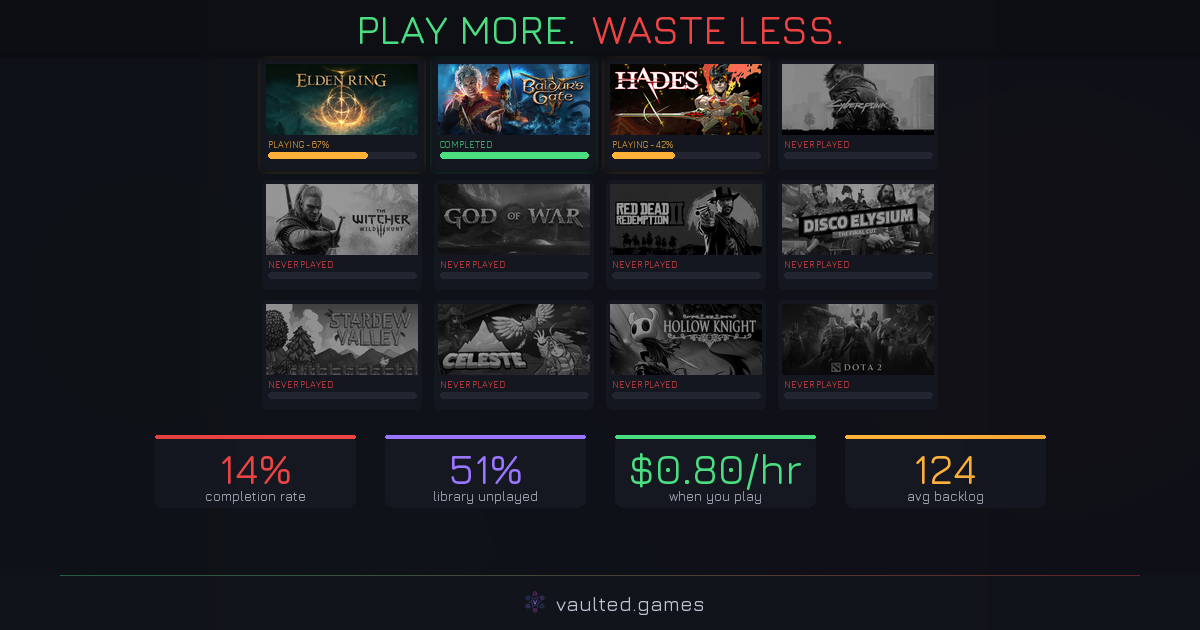
The average game completion rate on Steam is around 14%. The median gamer's backlog sits at 124 unplayed games. And there's an estimated $19 billion in purchased games across Steam that have never been launched. Not once.
The problem isn't that games are too expensive or that there aren't enough good ones. The problem is that the system is set up to make you buy, not play. Here's how to break that cycle.
The Real Cost of What You're Not Playing
U.S. consumer spending on video games hit $60.7 billion in 2025. The average household drops $449 a year on gaming. That's not an insignificant number, and it deserves the same scrutiny you'd give any other line item in your budget.
But the raw spending number isn't the real issue. It's the percentage of that spending that goes to waste. If the median Steam user leaves 51.5% of their library untouched, and the average household spends $449 a year, roughly half of that spending is producing zero entertainment value. That's not budgeting. That's throwing money away.
The industry makes this easy. 18,626 new games hit Steam in 2024 alone. Completing all of them would take an estimated 335,000 hours, roughly 38 years of nonstop play. The supply of games is functionally infinite. Your time and money are not.
Think in Cost-Per-Hour
The single most useful mental shift for gaming spending is cost-per-hour analysis. It's not about being cheap. It's about understanding where your money produces actual value.
Gaming is already one of the best entertainment deals around. Konvoy Ventures estimated gaming costs about $0.80 per hour of entertainment, on average. For comparison: a movie theater runs about $7.50 per hour, concerts are even higher, and streaming services like Netflix and Disney+ clock in around $0.28-$0.49 per hour.
But that $0.80 average hides enormous variation based on how you buy and what you actually play.
| Purchase | Price | Hours Played | Cost/Hour |
|---|---|---|---|
| AAA game at launch | $70 | 60 hours | $1.17 |
| Same game on 50% sale | $35 | 60 hours | $0.58 |
| Indie game played fully | $20 | 25 hours | $0.80 |
| AAA game abandoned after 3 hours | $70 | 3 hours | $23.33 |
| Sale impulse buy, never played | $8 | 0 hours | Infinite |
That last row is the killer. No matter how cheap a game is, if you never play it, the cost-per-hour is infinite. A $3 impulse buy you never launch costs more than a $70 game you put 200 hours into.
Before every purchase, check HowLongToBeat.com for realistic playtime estimates. Then ask: "Based on what I know about my habits, will I actually play this for X hours?" If the honest answer is "probably not," you just saved yourself money.
The One-In, One-Out Rule
Your backlog didn't appear overnight. It grew one impulse at a time, each purchase justified with "I'll get to it eventually." The one-in, one-out rule stops the bleeding.
The concept is simple. You can only buy a new game when you've finished or deliberately abandoned one from your backlog. "Finished" doesn't have to mean 100% completion. It means you've gotten the core experience, seen the credits roll, or made a conscious decision that the game isn't for you and you're done with it.
This does two things. First, it forces you to actually play your backlog. That Persona 5 you bought two years ago? Time to either play it or admit you're never going to and delete it from the guilt pile. Second, it slows down your purchasing rate to roughly match your actual play rate, which for most gamers is 10-15 completed games per year.
The rule isn't rigid. You can adjust it (two-in, one-out during a big sale month, for instance). But having any rule beats having none, which is how most gamers operate.
Strategic Patience Saves Real Money
AAA games follow predictable price curves. If you can wait, you save significantly.
1-3 months post-launch: First sale appears. Usually 10-30% off. Saves you $7-21 on a $70 game.
Around 7 months: Most AAA games hit 50% off. That $70 game is now $35, and it's been patched, reviewed by real players, and has DLC to evaluate.
12-24 months: Deep discounts of 75-90%. Games that were $70 at launch are $15-20.
Steam alone ran 20 sales in 2024. PlayStation and Xbox run their own major sales every few months. The opportunity to buy cheaper is always coming. The question is whether you have the patience to wait, and a system to remind you when the price drops.
Setting price alerts solves the patience problem. Add the game to your wishlist, set a target price, and forget about it. When it hits your number, you get notified. You buy it at the price you decided on in advance, when you were thinking rationally, not in the heat of a flash sale.
Vaulted.Games tracks prices across PlayStation, Xbox, Steam, and Nintendo storefronts. Set your target, get alerted, buy at the right time. No sale-page browsing required.
Audit Your Subscriptions Ruthlessly
The gaming subscription market is booming. $14.3 billion globally in 2025, growing at 14.3% annually. And 63% of U.S. gamers hold more than one subscription. But subscription value only materializes if you actually play the games.
The average Game Pass Ultimate subscriber plays through roughly $550 worth of games per year against a $360 annual cost. That's solid value. But it's an average. If you're the person who opens Game Pass once a month, plays for an hour, and goes back to your regular rotation, you're subsidizing that average for someone else.
PS Plus added 163 games in 2025, with an estimated retail value of $5,575. That's incredible on paper. In practice, how many of those 163 games will you actually play?
Run the audit every month. For each subscription, ask one question: "Did I play a game from this service in the last 30 days?" If the answer is no twice in a row, cancel. You can always resub when a game you want drops on the service. There's no penalty for coming and going. The companies want you to forget you're subscribed. Don't.
Kill Analysis Paralysis
You know the feeling. You sit down with an hour to play. You open Steam. Scroll. Nothing grabs you. Open the PS5. Scroll. Maybe that new thing on Game Pass? Open Xbox app. Scroll. Thirty minutes later you're on Reddit.
This is analysis paralysis, and it's devastating for gamers with large libraries. Classic psychology research (Iyengar & Lepper) showed that when consumers face 24 choices instead of 6, they're significantly less likely to make any choice at all. Your gaming library is the 24-jar problem on steroids.
Subscription services make it worse. Low per-game cost means zero commitment to anything. Why stick with a game that's merely good when there are 400 others you could try? So you sample, bounce, sample, bounce, and finish nothing.
Here are tactics that actually work against paralysis.
Pick your next game before you finish your current one. Don't wait until you're staring at the library. While you still have momentum from your current game, decide what's next.
Limit your "active" list to 3 games max. One primary game, one backup for when you need a change of pace, and one multiplayer/social option. Everything else is backlog. Don't even look at it until a slot opens up.
Use the 30-minute test. For backlog games you're not sure about, give them exactly 30 minutes. If you're engaged, keep going. If not, uninstall and move on without guilt. Not every game is for you, and admitting that is faster than letting it haunt your library for three years.
Finish What You Start (Or Quit Intentionally)
The average game completion rate across Steam titles with achievements is roughly 14%. That means about 1 in 7 players who start a game ever see the credits roll. Even popular AAA games hover around 20-33% completion rates on easy difficulty.
Some of that is expected. Not every game needs to be finished. Multiplayer games, roguelikes, and sandboxes don't have traditional endpoints. But a lot of it is gamers starting something, getting distracted by a new release or sale, and never coming back.
The fix isn't forcing yourself to finish everything. It's making quitting a deliberate choice instead of a passive drift. When you stop playing a game, actively decide: "Am I coming back to this, or am I done?" If you're done, mark it as abandoned and move on. If you're coming back, add it to your short list.
Tools that track your play progress across platforms make this way easier. When you can see "Last played: 47 days ago, 23% complete" for a game, the decision becomes clearer than when the game just sits silently in your library.
Buy for Your Actual Self, Not Your Aspirational Self
This is the one nobody talks about. You buy a 100-hour JRPG because you love the idea of playing a 100-hour JRPG. But your real life has you gaming 5-6 hours a week, and you know from experience that you tend to bounce off games after 15-20 hours.
Your actual gaming habits should drive your purchases, not your fantasy gaming habits.
If you finish games quickly and move on, lean into shorter experiences. If you tend to play one game for months, stop buying new releases every week. If you game in 30-minute sessions, open-world RPGs might not be your best investment no matter how good the reviews are.
Track your play time for a month. See what you actually play, how long your sessions are, and what types of games you stick with. Then buy accordingly. The gap between "gamer I think I am" and "gamer I actually am" is where most wasted money lives.
Build a System, Not Willpower
Willpower fails. Systems don't. The strategies above work best when they're built into how you interact with games, not treated as resolutions you have to remember.
- Wishlists with price alerts replace sale browsing
- The one-in-one-out rule replaces "I'll get to it later"
- Monthly subscription audits replace passive auto-renewals
- A 3-game active list replaces infinite scrolling
- Cost-per-hour thinking replaces price-tag thinking
Vaulted.Games was built around this idea. It syncs your libraries across PlayStation, Xbox, Steam, and Nintendo. Tracks what you own, what you're playing, and what's on your wishlist across every platform. Sets price alerts. Shows you your backlog in one place. It's a system for gaming smarter, not a test of willpower.
Because the gaming industry will never stop trying to sell you more than you can play. But you can build a process that makes sure the money you spend goes to games you actually enjoy.