

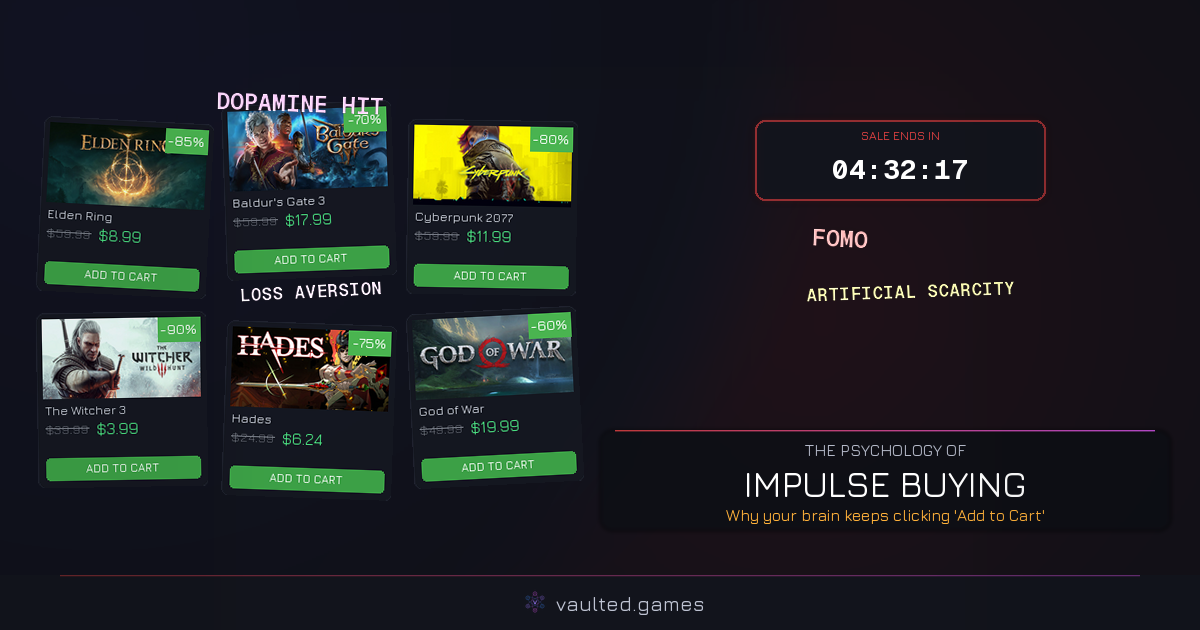
The Psychology Behind Impulse Gaming Purchases
There's $19 billion worth of unplayed games sitting in Steam libraries right now. Not "played a little." Never launched. And the median Steam user has over half their library completely untouched.
That's not a spending problem. That's a psychology problem.
The gaming industry has gotten incredibly good at separating you from your money, and the techniques aren't accidental. They're rooted in decades of behavioral psychology research, refined by some of the smartest product designers on the planet. Every countdown timer, every flash sale, every "limited time" banner exists because it works. On a neurological level.
Understanding why you impulse buy won't magically cure the habit. But it makes it a hell of a lot harder for these tactics to work on you once you see them for what they are.
Your Brain on Sales: The Dopamine Loop
Dopamine isn't the "pleasure chemical" most people think it is. It's actually the anticipation chemical. Your brain releases dopamine not when you get the reward, but when you expect one might be coming. Brain imaging studies published in Translational Psychiatry have shown that dopamine release during gaming occurs in the ventral striatum at levels comparable to psychostimulant drugs.
That's the same mechanism at play when you're browsing a Steam sale. Every game listing is a potential reward. Your brain is firing dopamine with each "80% off" tag, each trailer, each review score. By the time you've scrolled through 50 discounted games, your prefrontal cortex (the rational part that says "you already have 200 unplayed games") is getting drowned out by your reward system screaming "but this one's only $4!"
Neuroscience research confirms that increased dopamine activity directly heightens impulsive decision-making. You're not weak-willed. Your brain is literally optimized to pursue potential rewards, and game storefronts are designed to trigger that system as aggressively as possible.
FOMO: The Fear That Sells Games
Fear of Missing Out isn't just a social media thing. It's one of the most effective sales tools in gaming.
Limited-time sales. Rotating daily deals. Seasonal events. Battle pass seasons that expire. Games leaving subscription services. The message is always the same: buy now or lose the chance forever.
Research published in the European Journal of Business and Management Research directly links FOMO to impulsive purchasing behavior, especially in younger consumers. The mechanism is straightforward. When you believe an opportunity is temporary, the fear of loss overrides rational evaluation. You stop asking "do I actually want this?" and start asking "what if I miss it?"
Steam's seasonal sales are a masterclass in this. The entire event has a start date and an end date, creating an artificial window of scarcity. The game itself isn't scarce. It'll still be on Steam after the sale. It'll probably be on sale again in 3 months. But the deal feels scarce, and that feeling is enough.
55% of shoppers report feeling they must buy immediately when they think a deal might disappear. The gaming industry knows this number too.
Countdown Timers: Emotion Up, Logic Down
This one is straight-up neuroscience. Countdown timers on deals trigger the brain's amygdala (the emotional processing center) while simultaneously reducing activity in the prefrontal cortex (the rational decision-making center). You feel more. You think less. That's not a metaphor. It's measurable brain activity.
A 2024 study published in PMC confirmed the relationship between time pressure and impulsive buying. Time-limited discounts increase emotional arousal and pleasure, both of which accelerate purchasing decisions. The shorter the timer, the stronger the effect.
This is why flash sales, daily deals, and "ends in 4 hours" banners work so well. They're not just creating urgency. They're actively suppressing your ability to evaluate whether you actually want what you're buying.
The Sunk Cost Fallacy: Why You Keep Spending
You've spent $200 on a game's DLC and cosmetics. The game isn't even fun anymore. But quitting now means "wasting" that $200, so you keep playing. And spending.
That's the sunk cost fallacy, and it's deliberately exploited in game design. Once you've invested money (or time, or both) into a game, your brain treats walking away as a loss. Not a neutral decision. A loss. And humans hate losses roughly twice as much as they enjoy equivalent gains.
Published design analysis has identified the sunk cost fallacy as an intentional UX mechanic in gacha games and microtransaction-heavy titles. It's not a bug. It's a feature. The more you spend, the harder it becomes to stop, because stopping means accepting that the previous spending was, at least partially, wasted.
This compounds with subscription services too. "I'm already paying $30 a month for Game Pass, so I should play something from it even if nothing interests me." That logic keeps you subscribed whether you're getting value or not.
Variable Rewards: The Slot Machine in Your Games
B.F. Skinner figured this out in the 1950s with pigeons and levers. When rewards come on a predictable schedule, behavior tapers off. When rewards are random, the behavior becomes compulsive and persistent. Even when the rewards stop entirely.
This is the variable ratio reward schedule, and it's the psychological backbone of loot boxes, gacha mechanics, card packs, and randomized in-game drops. You don't know when you'll get the rare item, so you keep pulling. The anticipation, fueled by dopamine, keeps you engaged far longer than a guaranteed outcome would.
Games like Candy Crush, Genshin Impact, and virtually every live-service title with randomized rewards use this exact mechanism. It's the same psychology that makes slot machines addictive, and research backs this up. A 2025 Canadian study of 1,600 adults found that gamers who buy loot boxes are up to 2x more likely to gamble and more likely to develop gambling problems than those who don't.
Among regular loot box purchasers studied in academic research, 41% reported buying loot boxes more than once per week. Community participants averaged $240 in loot box spending. This isn't casual engagement. It's patterned behavior driven by variable reward psychology.
The Microtransaction Machine
58% of all PC gaming revenue in 2024 came from microtransactions. $24.4 billion. Not game sales. Not subscriptions. In-game purchases.
Microtransactions exploit several psychological principles simultaneously. Small individual amounts reduce the perceived cost (it's "just" $5 for a skin). Digital currency obscures real money value (is 1,000 V-Bucks a lot?). And purchase flows are deliberately streamlined to minimize friction between impulse and transaction.
A 2023 qualitative study in Computers in Human Behavior identified guilt, feeling "tricked," and a sense of obligation to keep playing as major themes in player microtransaction experiences. Players know it's happening to them. They just can't always stop it in the moment.
A 2024 study in ScienceDirect confirmed the pathway: virtual item drivers and flow experience predict impulse buying tendency, which directly predicts microtransaction purchase intention. The game creates the desire. The store removes the friction. The purchase happens before the rational brain catches up.
The Backlog as Evidence
If impulse buying in gaming were rare, backlogs would be small. They're not.
The numbers tell the story clearly. GameDiscoverCo analyzed hundreds of thousands of public Steam profiles in 2024 and found the average user leaves 32.7% of their library unplayed. The median player? 51.5% untouched. An older Ars Technica study pegged 36.9% of purchased Steam games as never loaded, with another 17% played for less than an hour.
That $19 billion in unplayed Steam games is the aggregate evidence of millions of individual impulse decisions. Each one felt justified in the moment. "It's only $3." "I'll play it this weekend." "I've been wanting this for months." But the data says otherwise.
80% of the 19,000 games released on Steam in 2024 launched to almost zero player engagement. The supply of games is overwhelming. And the human brain, running on dopamine-fueled anticipation and loss aversion, is fundamentally mismatched to this environment.
Fighting Back: What Actually Works
Understanding the psychology is step one. Here's what the research and practical experience suggest for step two.
Add friction to purchases. Remove saved payment methods from game stores. Make yourself type in your card number every time. This tiny barrier interrupts the impulse-to-purchase pipeline and gives your prefrontal cortex a few seconds to catch up.
Use wishlists as a cooling-off period. When you see a game you want, add it to a wishlist instead of buying it. Set a personal rule: nothing gets purchased until it's been on your wishlist for at least 7 days. Tools like Vaulted.Games let you manage wishlists across every platform in one place, so you can track what you actually want versus what caught your eye for 30 seconds.
Set price alerts instead of browsing sales. Browsing a sale page is walking into a dopamine gauntlet. Instead, decide what you want ahead of time and set alerts for when those specific games hit your target price. You get the deal without the exposure to thousands of other "deals" designed to trigger impulse buys.
Track what you play, not just what you buy. Most gamers can name the last game they bought but not the last game they finished. Shifting focus to play tracking (what are you actually spending time on?) reframes the relationship from consumption to experience.
Recognize the tactics in real time. That countdown timer is suppressing your rational brain. That "leaving soon" label is manufacturing FOMO. That loot box is a Skinner box. Once you can name the technique being used on you, it loses most of its power. Not all of it. But enough to pause and make a deliberate choice.