The Smart Gamers Guide to Never Overpaying for Games
You're overpaying for games. Not because you're careless, but because the system is designed that way.
Publishers want you to buy at launch. Storefronts want you to impulse purchase. And the constant stream of new releases creates FOMO that empties wallets faster than any subscription fee.
The reality? Most games drop 30-50% within three to six months of release. Some hit 75% off within a year. And if you're strategic about it, you can play the same games as everyone else while spending half as much.
Here's how.
Quick Answer: How Do I Stop Overpaying for Games?
The short version:
- Wait 3-6 months after launch for the first major sale (30-50% off)
- Know the sale calendar (Steam Summer/Winter, Black Friday, platform anniversary sales)
- Set price alerts so deals come to you instead of hunting for them
- Check your subscriptions first before buying anything
- Play your backlog while waiting for prices to drop
- Buy complete editions instead of base game + DLC separately
- Compare across platforms since the same game often has different prices
Now let's break each one down.
1. The 3-6 Month Rule
Here's the uncomfortable truth about game pricing: you're paying a premium to play at launch.
| Time After Release | Typical Discount | Example ($70 Game) |
|---|---|---|
| Launch day | 0% | $70 |
| 1-2 months | 10-20% | $56-63 |
| 3-6 months | 30-50% | $35-49 |
| 12 months | 50-75% | $17-35 |
| 18+ months | 75-90% | $7-17 |
That $70 game you bought at launch? It's probably $35 right now. And in a year, it'll be $20 or less.
The exception: Nintendo first-party titles. Mario, Zelda, and Pokemon games rarely drop below $40 and often stay at full price for years. If you want a Nintendo exclusive, waiting doesn't save much.
The strategy: Unless a game is multiplayer-dependent (where the community matters), waiting a few months costs you nothing but saves you real money.
2. Know the Sale Calendar
Game sales aren't random. They follow predictable patterns:
Steam Sales (PC)
| Sale | Typical Timing | Discount Level |
|---|---|---|
| Winter Sale | Dec 21 - Jan 4 | Best of the year |
| Summer Sale | June 22 - July 6 | Major discounts |
| Spring Sale | March | Moderate |
| Autumn Sale | November | Good, pre-Black Friday |
Steam also runs themed sales (horror games in October, sports games during championships) with solid discounts.
Console Sales
| Platform | Major Sales | Notes |
|---|---|---|
| PlayStation | Days of Play (June), Holiday Sale (Dec), Weekly sales | PS+ members get extra discounts |
| Xbox | Ultimate Game Sale (July), Black Friday, weekly Deals with Gold | Game Pass sometimes makes buying unnecessary |
| Nintendo | Rarely | eShop sales exist but discounts are modest (30-40% typical) |
Cross-Platform Events
- Black Friday/Cyber Monday (November): Best cross-platform discounts of the year
- Publisher Sales: EA, Ubisoft, and others run their own sales tied to events or anniversaries
- The Game Awards (December): Publishers often discount nominated titles
The strategy: If a game you want isn't on sale, check when the next major sale is. If it's within 4-6 weeks, wait.
3. Set Price Alerts (Stop Hunting for Deals)
Checking five different storefronts every day is a waste of time. Set it and forget it.
How price alerts work:
- Add a game to your tracking list
- Set your target price (the most you're willing to pay)
- Get notified when it hits that price
- Buy it and move on
Where to set alerts:
- IsThereAnyDeal (PC): Tracks dozens of legitimate PC storefronts
- Deku Deals (Nintendo): Comprehensive Switch eShop tracking
- PSprices (PlayStation): PSN sale tracking
- Vaulted.Games: Cross-platform tracking in one place (yes, that's us)
Pro tip: Set your target price at the historical low. If a game has hit $15 before, there's no reason to pay $25 for it now.
4. Check Your Subscriptions First
This sounds obvious, but most gamers don't do it.
Before buying any game, check:
- Game Pass (Xbox/PC): 400+ games, including day-one Microsoft releases
- PS Plus Extra/Premium: 400+ games in the catalog
- EA Play: Included with Game Pass Ultimate, or standalone
- Ubisoft+ Classics: Included with PS Plus Extra and Game Pass Ultimate
- Nintendo Switch Online: NES, SNES, N64, GBA libraries
The mistake: Buying a game that's already included in a service you pay for. It happens more than you'd think, especially when catalogs rotate monthly.
The bigger mistake: Not checking if a game is coming to a subscription soon. Publishers sometimes announce additions weeks in advance.
The problem: Checking five different apps and websites before every purchase is tedious. Most people skip it.
The solution: Vaulted.Games tracks your subscriptions and tells you instantly if a game you want is already available or coming soon. One search instead of five.
The strategy: Before any purchase, spend 30 seconds checking. If it's there or coming soon, you just saved $30-60.
5. Play Your Backlog
The average gamer has 70+ unplayed games in their library. You probably have games you bought on sale and never touched.
Here's the counterintuitive advice: your backlog is a money-saving tool.
Every game in your backlog is a game you don't need to buy right now. While you're playing through your existing library, the games you want are getting cheaper.
The math:
- You have 10 unplayed games averaging 20 hours each = 200 hours of entertainment
- That's 4+ months of gaming if you play 10 hours/week
- In 4 months, most new releases drop 30-50%
The strategy:
- Pick 2-3 games from your backlog
- Commit to finishing (or deciding you're done with) them before buying anything new
- By the time you're done, the games on your wishlist will be cheaper
This isn't about being cheap. It's about actually playing what you own.
6. Buy Complete Editions
DLC pricing is where publishers really get you.
Base game + all DLC separately:
- Base game: $60
- Season Pass: $40
- Extra DLC: $10-20
- Total: $100-120
Complete/GOTY Edition (one year later):
- Everything included: $30-40
The complete edition often costs less than the original base game.
When to buy DLC separately:
- You already own the base game and love it
- The DLC is substantial (full expansions, not cosmetics)
- It's on deep discount (50%+ off)
When to wait for the complete edition:
- You don't own the game yet
- The game has a known DLC roadmap
- You can wait 12-18 months
7. Compare Across Platforms
The same game can have wildly different prices depending on where you buy it.
PC has the most options:
- Steam, Epic Games Store, GOG, Humble Bundle, Fanatical, Green Man Gaming, and more
- Prices vary significantly between storefronts
- Epic often has exclusive coupons ($10 off purchases over $15)
Cross-platform comparison:
A new release might be $70 on PlayStation but $50 on PC during a sale. If you have multiple platforms, check all of them.
Key-seller warning: Sites selling "cheap" keys often source them questionably. Stick to authorized retailers. If a price seems too good to be true, it probably is.
Common Mistakes to Avoid
1. Pre-ordering
You're paying full price for a game you Haven't played, based on marketing. Wait for reviews. Wait for patches. Wait for the first sale.
The only exception: Limited collector's editions you genuinely want for the physical items.
2. Buying Games You Won't Play
Sale prices feel like savings, but buying a $60 game for $15 isn't saving $45 if you never play it. It's spending $15 on nothing.
Be honest: will you actually play this in the next 6 months?
3. Ignoring Subscription Catalogs
Check Game Pass, PS Plus, and other services before every purchase. Catalogs update monthly.
4. FOMO Buying
"Everyone's playing it" is marketing psychology, not a reason to spend money. Most games are just as good three months later. The discourse moves on, but the game doesn't.
5. Double-Dipping
Buying a game on multiple platforms because you "might want to play it there." You won't. Pick one.
The Buy Now vs. Wait Decision Framework
Use this when you're tempted to purchase:
Buy now if:
- It's a multiplayer game where community size matters
- It's already at or near historical low price
- You will literally start playing it today
- It's a Nintendo first-party title (prices don't drop much)
Wait if:
- You have unplayed games in your backlog
- A major sale is coming within 4-6 weeks
- The game just launched (3-6 month rule)
- You're not sure you'll actually play it
- DLC is still being released (wait for complete edition)
How Much Can You Actually Save?
Let's do the math on a typical year of gaming:
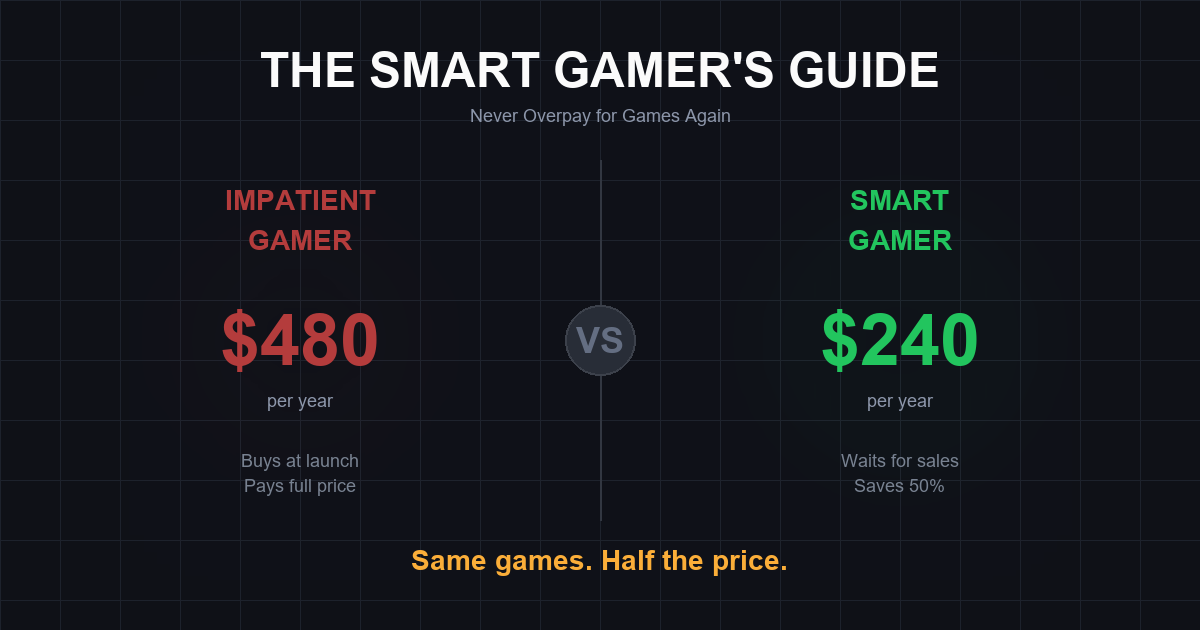
Impatient gamer (buys at launch):
| Purchase | Price |
| 4 AAA games at launch | $280 |
| 6 indie games at launch | $120 |
| 2 DLC season passes | $80 |
| Annual total | $480 |
Patient gamer (uses these strategies):
| Purchase | Price |
| 4 AAA games at 50% off | $140 |
| 6 indie games in bundles/sales | $40 |
| 2 complete editions (includes DLC) | $60 |
| Annual total | $240 |
Annual savings: $240
That's $240 for the same games, just purchased smarter. Over five years? $1,200.
Track Everything in One Place
Managing wishlists across Steam, PlayStation, Xbox, Nintendo, and subscription services is a headache. Games get added to catalogs. Sales come and go. Prices fluctuate.
Vaulted.Games was built to solve this:
- One wishlist across all platforms
- Price alerts that notify you when games hit your target
- Subscription tracking so you never buy a game you can already play
- Historical price data so you know if a "sale" is actually a good deal
Stop overpaying. Start playing.
The Bottom Line
Smart gaming isn't about being cheap. It's about getting maximum value from your entertainment budget.
The core principles:
- Wait 3-6 months for prices to drop
- Know when sales happen
- Set alerts instead of hunting for deals
- Check subscriptions before buying
- Play your backlog while waiting
- Buy complete editions
- Compare prices across platforms
The game industry wants you to buy impulsively. These strategies put you back in control.
FAQ: Saving Money on Games
How long should I wait to buy a new game?
For most games, waiting 3-6 months gets you 30-50% off. Waiting 12 months often means 50-75% off. The exception is Nintendo first-party titles, which rarely discount significantly.
What's the best time of year to buy games?
Black Friday/Cyber Monday (November) and Steam Winter Sale (late December) offer the deepest discounts across all platforms. Steam Summer Sale (late June) is also excellent for PC.
Is Game Pass worth it if I want to own my games?
Game Pass is best for trying games and playing through them once. If you want permanent ownership, wait for sales. Many Game Pass games eventually hit $10-15 on sale, less than two months of subscription.
Should I ever pre-order games?
Almost never. Pre-order bonuses are rarely valuable, and you lose the ability to wait for reviews, patches, and price drops. The only exception is limited physical collector's editions.
How do I know if a sale price is actually good?
Check historical pricing. Sites like IsThereAnyDeal (PC), Deku Deals (Switch), and Vaulted.Games show price history. If the "sale" price is higher than previous lows, it's not a real deal.