Gaming Fatigue Is Real: How to Stop Burning Out on Games
You have 200+ games in your library. Three active subscriptions. A backlog that grows faster than you can play. And somehow, when you finally sit down to game, you spend 20 minutes scrolling through Game Pass, close it, and watch YouTube instead.
That's gaming fatigue. And it's more common than you think.
This isn't a "touch grass" lecture. If you're here, you love gaming. You just hit a wall, and the usual advice of "take a break" doesn't address why it happened in the first place. Let's dig into the real causes and, more importantly, what actually works to fix it.
What Does Gaming Fatigue Actually Look Like?
Gaming fatigue doesn't announce itself. It creeps in. Here's what it looks like in practice:
The scroll-and-close cycle. You open Game Pass, PlayStation Store, or your Steam library. You scroll. And scroll. Nothing grabs you. You close the app and do something else. This is the most common symptom, and it's frustrating because you want to play something, you just can't pick.
The guilt loop. You feel bad about the 30 games in your backlog. So you don't buy anything new. Then a sale drops and you grab three more games "for later." The backlog grows. The guilt grows. Repeat.
The "nothing sounds fun" wall. You have literally hundreds of options and none of them appeal to you. It's not that the games are bad. Your brain is overloaded with choices and just says "nah" to all of them.
Watching instead of playing. You'd rather watch someone else play on YouTube or Twitch than boot up a game yourself. When spectating feels easier than participating, something's off.
If any of this sounds familiar, you're not broken and you're not "over" gaming. Your brain is just dealing with something psychologists have been studying for decades.
Why Is Gaming Burnout Happening?
The causes are a mix of industry trends and basic human psychology. Let's break them down.
Subscription Overload and Choice Paralysis
Game Pass. PS Plus. Nintendo Switch Online. EA Play. Ubisoft+. Each one dumps new titles into your library every month.
Here's the problem: more choices don't make you happier. Psychologist Barry Schwartz called this the Paradox of Choice. The famous "jam study" by Columbia University professor Sheena Iyengar demonstrated it perfectly. When a store displayed 24 flavors of jam, 60% of shoppers stopped to look but only 3% bought anything. When they cut it down to 6 flavors, purchases jumped to 30% (The Decision Lab).
Researchers at Caltech found that the sweet spot for decision-making is around 8 options, plus or minus two. Game Pass alone has 400+ titles. That's not a library, it's a wall of noise.
When everything is "free" on your subscription, nothing feels valuable. There's no investment driving you to actually play. And the constant rotation of games leaving and arriving creates a low-grade anxiety that you should be playing something right now before it disappears.
FOMO-Driven Purchasing
Steam sales, PlayStation flash deals, humble bundles. You see 80% off and your brain says "I'd be stupid NOT to buy this." So you do. Then it sits in your library untouched for two years.
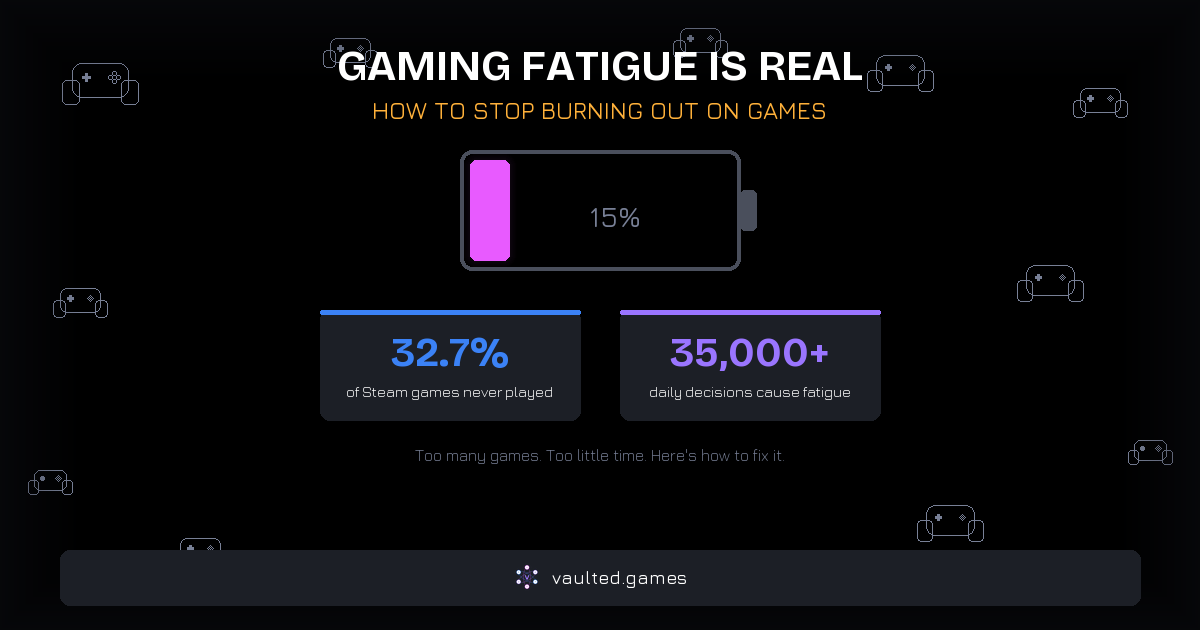
The data backs this up. On average, 32.7% of games in Steam libraries have never been launched. The median Steam user has 51.5% of their library unplayed. Collectively, Steam users have spent an estimated $19 billion on games they've never played.
Your wishlist became a shopping list instead of a play list. Every sale is a chance to "save money" on games you'll never touch. That's not saving, that's hoarding.
Open-World Fatigue
Every major AAA release is a 60-100 hour commitment. Map icons. Collectibles. Side quests. Crafting systems. Skill trees. It's exhausting.
Former PlayStation boss Shawn Layden said it directly: "100-hour games are a mismatch for today's reality." And he's right. Most of us don't have the bandwidth for a second full-time job disguised as entertainment.
When every game demands dozens of hours just to see the main story, it starts feeling like work. Gamers have started calling open-world games "to-do list simulators" and "chores with RTX lighting" (KeenGamer). That's not healthy for the hobby.
The "I Should Be Playing X" Guilt
Social media and gaming communities create constant pressure. Elden Ring is a masterpiece, you HAVE to play it. Baldur's Gate 3 is game of the year, what do you mean you haven't started it? Palworld is trending, jump in now before it dies.
Gaming stops being something you do for fun and becomes something you do to keep up. That shift from intrinsic motivation (playing because you want to) to extrinsic pressure (playing because everyone says you should) kills enjoyment fast.
Decision Fatigue Hits Hardest at Night
Here's one most people don't consider. Research shows the average person makes over 35,000 decisions per day (The Decision Lab). By evening, your prefrontal cortex (the part of your brain responsible for decisions) is running on fumes.
Now think about when most of us game. After work. After dinner. After the kids are in bed. You're mentally tapped out, and the last thing your brain wants to do is make another decision about which of your 400 games to play.
So you default to scrolling, or rewatching a comfort show, or just going to bed. It's not laziness. It's your brain being out of gas.
How to Actually Fix Gaming Fatigue
Enough about the problem. Here's what works.
Audit Your Subscriptions (Seriously)
Pull up your bank statement and look at what you're paying monthly for gaming subscriptions. Game Pass Ultimate ($19.99), PS Plus Premium ($17.99), Nintendo Switch Online + Expansion ($49.99/year), EA Play, Ubisoft+. Add it up.
Now ask yourself: when was the last time you played a game on each service? If you haven't touched a subscription in two months, cancel it. You can always resub when something you actually want drops.
This does two things: saves you money AND reduces the firehose of choices hitting you every month. Fewer options means easier decisions. For a deeper breakdown, check out our Game Subscription Services Compared guide.
Try the "One In, One Out" Rule
Don't start a new game until you either finish your current one or deliberately quit it. The key word is deliberately. Give yourself permission to drop a game that isn't clicking. Not every game needs to be finished. Some games are 7/10 for the first five hours and that's all you needed from them.
But bouncing between six games at once means you never get invested in any of them. Pick one. Commit to it for a few sessions. If it's not working, move on intentionally and pick your next one.
Use Short Games as Palate Cleansers
After grinding through a 60-hour RPG, the last thing you need is another 60-hour RPG. Play something short. Something you can finish in one or two sessions.
Games like Journey (2 hours), Firewatch (4 hours), A Short Hike (2 hours), What Remains of Edith Finch (2 hours), or Inside (3 hours) are perfect for this. They're complete, satisfying experiences that reset your brain and remind you why you like games in the first place.
Short doesn't mean lesser. Some of the best gaming experiences of the last decade are under five hours.
Curate, Don't Accumulate
Your backlog should be a short list of games you're genuinely excited to play. Not a museum of every game you've ever bought or claimed.
Here's a rule: keep your active backlog to 10 games or fewer. Everything else goes into an archive. You're not deleting anything, you're just being honest about what you're actually going to play next. If your backlog has 200 games in it, it's not a backlog, it's a graveyard.
We wrote a full guide on this: How to Build Your Gaming Backlog (And Actually Play It).
Schedule Your Gaming Time
This sounds weird, but hear me out. "Tuesday and Thursday nights are gaming nights" removes the daily decision of should I game tonight? It's already decided. You just sit down and play.
This is especially useful if you're a parent, work long hours, or have a packed schedule. When gaming time is defined, you stop feeling guilty about not gaming on the other nights and you stop agonizing over whether tonight is "worth" booting something up.
Take Intentional Breaks (Not Guilt Breaks)
It's OK to not game for a week. Or two. The difference between an intentional break and a guilt break matters.
An intentional break is: "I'm going to read a book / go hiking / try cooking something new this week. I'll come back to gaming next week fresh."
A guilt break is: "I should be gaming but nothing sounds fun and I feel bad about it so I'm just going to avoid my console entirely."
One recharges you. The other makes the fatigue worse. When you come back from a real break, games feel exciting again. You'll have that moment where you're genuinely itching to play something, and that feeling is worth protecting.
Stop Treating Gaming Like a Checklist
You don't need to 100% every game. You don't need to finish every game. You don't need to play every game that gets critical acclaim.
Play until you're having fun. When the fun stops, move on. That's it. No guilt. No obligation. Games are entertainment, not homework.
The completionist mindset is one of the biggest drivers of gaming burnout. Chasing platinum trophies and achievements turns a fun hobby into an unpaid job. Be selective about which games you go deep on.
How Tracking Tools Help (Without the Sales Pitch)
One practical thing that helps with gaming fatigue: knowing what you actually have. Sounds basic, but most gamers can't tell you off the top of their head which games they own across which platforms, which ones overlap between subscriptions, and what they've actually been playing.
Track what you play, not just what you own. When you can see that you've only played 3 games in the last month despite owning 200, it's a reality check. It helps you stop buying and start playing.
Find your subscription overlap. If the same game is available on Game Pass AND your PS Plus catalog, you're paying for access to it twice. Knowing this saves money and simplifies your choices.
Keep a curated backlog. A focused list of 5-10 games you're excited about beats a spreadsheet of 200 titles you'll never touch. Tools like Vaulted.Games let you manage wishlists and backlogs across every platform in one place, so you always know what's next without the scroll-and-close cycle.
The point isn't to add another app to your life. It's to spend less time managing games and more time playing them.
Key Takeaways
- Gaming fatigue is a real psychological response, not a sign you're "over" gaming. Choice paralysis, decision fatigue, and subscription overload are documented phenomena.
- The average Steam user has over half their library unplayed. You're not alone in buying more than you play.
- Audit your subscriptions. Cancel what you're not using. Fewer choices = easier decisions = more fun.
- Keep your active backlog to 10 games or fewer. Be honest about what you're actually going to play next.
- Use short games to reset. A 2-hour indie can be more satisfying than 30 hours of open-world filler.
- Schedule gaming time and take real breaks. Structure removes decision fatigue, and intentional breaks recharge the fun.
- Stop 100%-ing everything. Play until the fun stops, then move on without guilt.
Gaming is supposed to be the thing you look forward to after a long day. If it's starting to feel like another obligation, these strategies work. Start with one, see how it feels, and adjust from there.
Want to get your gaming life organized? Vaulted.Games helps you track prices, manage backlogs, and cut subscription waste across PlayStation, Xbox, Nintendo, and Steam, all in one place.