
The Gamer's Budget Guide: How to Spend Less Without Playing Less
You probably have no idea how much you actually spend on games every year. Most people don't.
Between full-price launches, subscription fees, DLC, season passes, microtransactions, and those "it's only $5" impulse buys during a Steam sale, the number adds up fast. The average North American gamer spends $329 per year on gaming, according to industry data. American households average $449 per year when you include hardware and accessories.
And here's the part that stings: nearly a quarter of purchased games never get played at all. On Steam specifically, the median player has 51.5% of their library sitting untouched.
You're not just overspending. You're overspending on stuff you don't even use.
Let's fix that.
How Much Do Gamers Actually Spend?
Let's put some numbers on it. U.S. consumer spending on video games hit $60.7 billion in 2025, the second-highest year on record. Subscription service spending alone jumped 20% year over year.
Here's where it gets personal:
| Spending Category | Typical Annual Cost |
|---|---|
| 1-2 subscriptions (Game Pass, PS+) | $120-360 |
| 4-6 full-price game purchases | $280-420 |
| DLC and season passes | $40-100 |
| Microtransactions | $50-200+ |
| Impulse sale purchases | $50-150 |
| Estimated Total | $540-1,230 |
That range is wide because spending habits vary wildly. But most gamers who buy a mix of new releases and sale titles, keep a subscription or two, and occasionally grab DLC are landing somewhere in the $500-800 range without realizing it.
The Impulse Buy Problem
Steam sales, PS Store flash deals, Epic freebies. They all trigger the same response: "It's only $5, why not?"
Because twenty of those "only $5" purchases is $100. And statistically, you'll play maybe half of them. That's $50 burned on games you opened once (or never).
A survey of over 2,000 gamers found that less than half (44%) of digital PC games in people's libraries get played regularly. The rest sit there, gathering digital dust, making you feel guilty every time you scroll past them.
Quick Self-Assessment
Pull up your purchase history right now. PlayStation Store, Steam, Xbox, wherever you buy games. Add up the last 3 months. Include subscriptions, microtransactions, and DLC.
Surprised? Most people are.
The Gaming Budget Framework
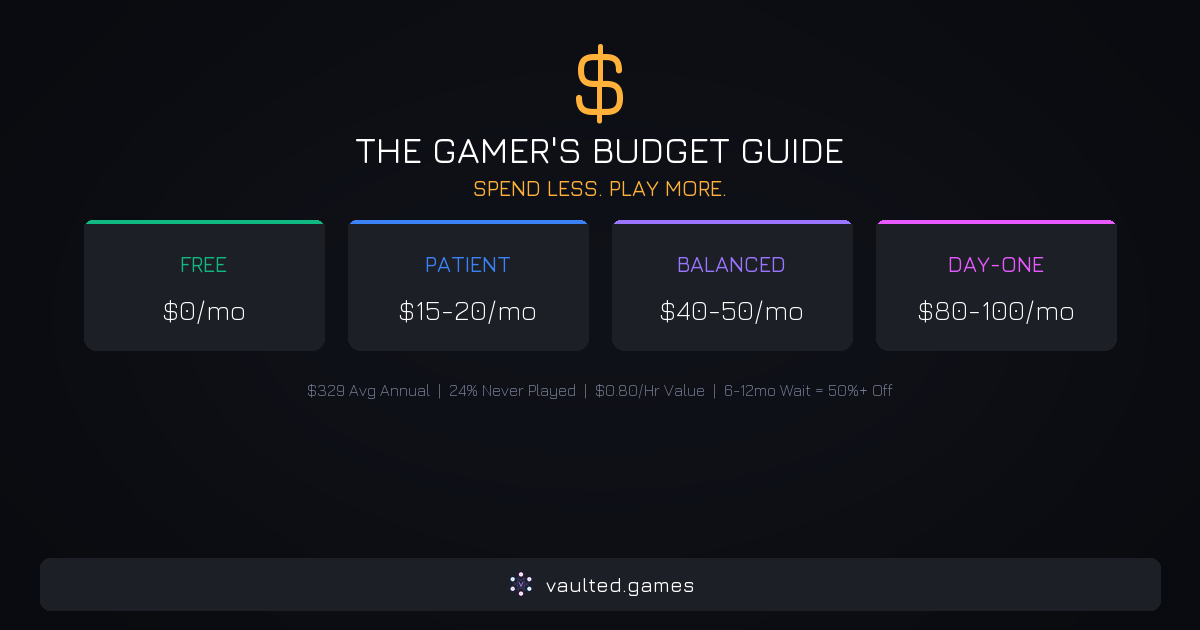
Here's a practical breakdown of what gaming looks like at different monthly spending levels. Find where you are, then decide where you want to be.
$0/Month: The Free Tier
You can game for literally $0 per month and still have more than enough to play. The free-to-play landscape in 2026 is absurdly good.
Games worth your time for $0:
- Fortnite, Warzone, Apex Legends (battle royale)
- Genshin Impact, Honkai: Star Rail (RPG)
- Path of Exile 2 (action RPG)
- Valorant, Counter-Strike 2 (competitive shooters)
- Rocket League (sports/arcade)
Free games from subscriptions you might already have:
- PS Plus Essential monthly games (if you're already subscribed)
- Epic Games Store gives away free games every week
- Amazon Prime Gaming includes monthly titles
The catch: "Free" doesn't mean zero cost if you're dropping $20 here and there on skins, battle passes, and microtransactions. Track that spending. It's real money even if it doesn't feel like a "purchase."
$15-20/Month: The Patient Gamer
This is the sweet spot for value. One subscription and strict discipline on purchases.
The strategy:
- Pick one subscription: Game Pass Essential ($14.99/mo) or PS Plus Essential ($9.99/mo)
- Buy games only when they hit 50% off or more
- Typical wait time: 6-12 months after launch for most titles to hit that threshold
What this gets you:
- Access to hundreds of games through your subscription
- 2-3 deeply discounted purchases per month
- 90% of the gaming experience for about 25% of the cost compared to buying everything at launch
This tier works best for people who don't mind waiting. If you can stay off social media spoilers for 6 months, you'll play the same games as everyone else for a fraction of the price. The r/PatientGamers community has turned this into an art form.
$40-50/Month: The Balanced Gamer
This is where most gamers should probably land. Enough budget for a premium subscription plus room for targeted purchases.
The strategy:
- One premium subscription (Game Pass Premium at $14.99/mo or PS Plus Extra at $13.99/mo)
- Budget for 1-2 sale purchases per month
- Reserve one day-one purchase per quarter for genuine must-haves
- Everything else goes on the wishlist and waits for a sale
What this gets you:
- Day-one access to select titles through your subscription
- Flexibility to grab a big release when something truly can't wait
- A growing backlog of quality games bought at smart prices
The key discipline here: not every game is a day-one purchase. Pick your battles. That AAA title you're "kinda interested in" will be 40% off in 3 months.
$80-100/Month: The Day-One Gamer
Multiple subscriptions, day-one purchases, deluxe editions. This tier is fine IF you're actually playing everything you buy.
What this usually looks like:
- 2+ subscriptions (Game Pass Ultimate at $29.99/mo + PS Plus Extra/Premium)
- 1-2 day-one purchases per month
- Deluxe/Ultimate editions for anticipated titles
- DLC and season passes for ongoing games
The real question: It's not "can you afford this?" It's "are you getting $80-100 worth of actual playtime every month?" If you're buying 3 games and only finishing 1, you're not a Day-One Gamer. You're a Day-One Collector.
Track your cost per game played (total monthly spend divided by games you actually played that month). If that number makes you uncomfortable, drop down a tier.
The Cost-Per-Hour Framework: Is This Game "Worth It"?
Price tags lie. A $70 game and a $20 game can deliver wildly different value depending on how much time you spend with them.
The Math
| Scenario | Price | Hours Played | Cost Per Hour |
|---|---|---|---|
| AAA game you love | $70 | 40 hours | $1.75/hr |
| AAA game you quit | $70 | 3 hours | $23.33/hr |
| Indie game on sale | $10 | 20 hours | $0.50/hr |
| Free-to-play game | $0 | 200 hours | $0.00/hr |
| Subscription (monthly) | $15 | 30 hours | $0.50/hr |
That $70 game you played for 40 hours? $1.75 per hour. That's cheaper than basically any other form of entertainment.
That $70 game you bounced off after 3 hours? $23.33 per hour. You could've gone to a nice dinner instead.
How Gaming Compares to Other Entertainment
Gaming is one of the cheapest forms of entertainment per hour. Here's how it stacks up:
| Entertainment | Avg. Cost Per Hour |
|---|---|
| Video games (engaged player) | $0.80 |
| Streaming services | $0.60-5.00 |
| Books (new paperback) | $1.50-3.00 |
| Movie theater | $5.00-8.00 |
| Concerts | $50-200+ |
| Live sports | $30-100+ |
Sources: Konvoy Ventures analysis, average movie ticket price of $16.08 in 2025 for a 2-hour film, concert ticket averages from SeatData.
Gaming wins on a per-hour basis, but only if you actually play what you buy. Every unplayed game in your library is dragging that average up.
A Word of Warning
Don't let cost-per-hour become a reason to only play massive 100-hour open world games. A 3-hour indie game that hits you emotionally is worth more than a 100-hour slog you're only finishing because you "paid for it."
Cost-per-hour is a tool for evaluating purchases before you buy, not a reason to force yourself through a game you're not enjoying.
The Price Decay Curve: When Should You Buy?
Almost every game gets cheaper over time. The question is how long you're willing to wait.
Typical AAA Price Drops
| Time After Launch | Typical Price | Savings vs. Launch |
|---|---|---|
| Launch day | $69.99 | 0% |
| 3 months | $49.99-59.99 | 15-30% |
| 6 months | $29.99-39.99 | 40-55% |
| 12 months | $19.99-29.99 | 55-70% |
| 18+ months | $9.99-14.99 | 75-85% |
| Added to subscription | $0 (included) | 100% |
The patient gamer math: Waiting just 6 months saves you 40-55% on most AAA titles. That $70 game becomes a $30-40 game. Wait a full year and you're looking at $20-30. Wait 18 months and you might grab it for under $15.
For a deeper look at exactly when Steam sales happen and how to time your purchases, check out our complete 2026 Steam sale schedule.
The Nintendo Exception
Nintendo games are the one major exception to the price decay curve. First-party Nintendo titles hold their value stubbornly. Zelda: Tears of the Kingdom still hovers around $50-60 two years after launch. Don't expect steep discounts on Mario, Zelda, or Pokemon titles anytime soon.
For more on the pricing landscape across all platforms, our breakdown of why games cost $70-80 now covers the full picture and strategies to avoid paying full price.
Will Game Prices Go Down?
Short answer: No. The trend is going up, not down.
The $60 standard held for nearly 20 years. Then it moved to $70 in 2022-2023. In 2025, Nintendo set its Switch 2 launch titles at $80, and Microsoft followed with its own price increases. Analysts expect GTA 6 to land between $70-80 for the base version, with deluxe editions pushing well past $100.
But here's the good news: while sticker prices are rising, the tools to avoid paying full price have never been better.
- More subscriptions than ever (Game Pass, PS Plus, EA Play, Ubisoft+)
- More frequent sales across all platforms
- More quality free-to-play games than any previous generation
- Better price tracking tools that tell you exactly when to buy
The sticker price going up doesn't matter if you never pay sticker price. Patient gamers in 2026 have more options to save money than at any point in gaming history.
We broke down the full economics in our guide on why games cost $70-80 now and how to never pay full price.
Your Gaming Budget Template
Here's a simple monthly tracker. Copy it, put it in a spreadsheet, and fill it in for one month. Just one. The results will either confirm you're spending wisely or give you the kick you need to adjust.
| Category | Monthly Budget | Actual Spend | Notes |
|---|---|---|---|
| Subscriptions | $ | Game Pass, PS+, etc. | |
| New Game Purchases | $ | Full-price or sale | |
| DLC / Season Passes | $ | ||
| Microtransactions | $ | Be honest with yourself | |
| Monthly Total | $ | ||
| Annual Projection | $ (x12) |
Tips for Actually Using This
Review monthly. It takes 5 minutes. Look at what you spent and what you actually played. If you bought 4 games and played 1, that's a problem worth addressing.
Track cost per game played. Total monthly spend divided by the number of games you actually played that month. If you spent $100 and played 2 games, your effective cost is $50 per game. That's a $70 AAA title level of spending on games you probably bought on sale.
Set a cooling-off rule. Wishlist a game for at least 7 days before buying it. If you still want it after a week, go for it. You'll be surprised how many impulse buys die in the wishlist. This one habit alone can save you hundreds per year.
Compare subscription vs. buying. If you're playing 3+ games per month from your subscription catalog, that subscription is saving you money. If you're only touching 1 game per month on Game Pass, you might be better off just buying that one game on sale. We compared every major subscription service in our full comparison guide.
Key Takeaways
- The average North American gamer spends $329/year, but most people tracking carefully find they're spending $500-800+. Know your actual number.
- Nearly a quarter of purchased games never get played. Every unplayed game is wasted money.
- The $15-20/month tier (one subscription + patient buying) gets you 90% of the experience for a fraction of the cost.
- Waiting 6 months saves 40-55% on almost every AAA title. Waiting 12 months saves 55-70%.
- Gaming costs $0.80/hour on average, making it one of the cheapest entertainment options per hour. But only if you play what you buy.
- Game prices are going up ($70 to $80), but the tools to save money are better than ever.
- Track your spending for one month. Just one. The awareness alone changes behavior.
Stop guessing what you spend on gaming and start knowing. And if you want to make it easier, Vaulted.Games tracks prices across PlayStation, Xbox, Steam, and Nintendo so you can set alerts and buy at the right time instead of the wrong one.