

Why Games Cost $70-80 Now (And How to Never Pay Full Price)
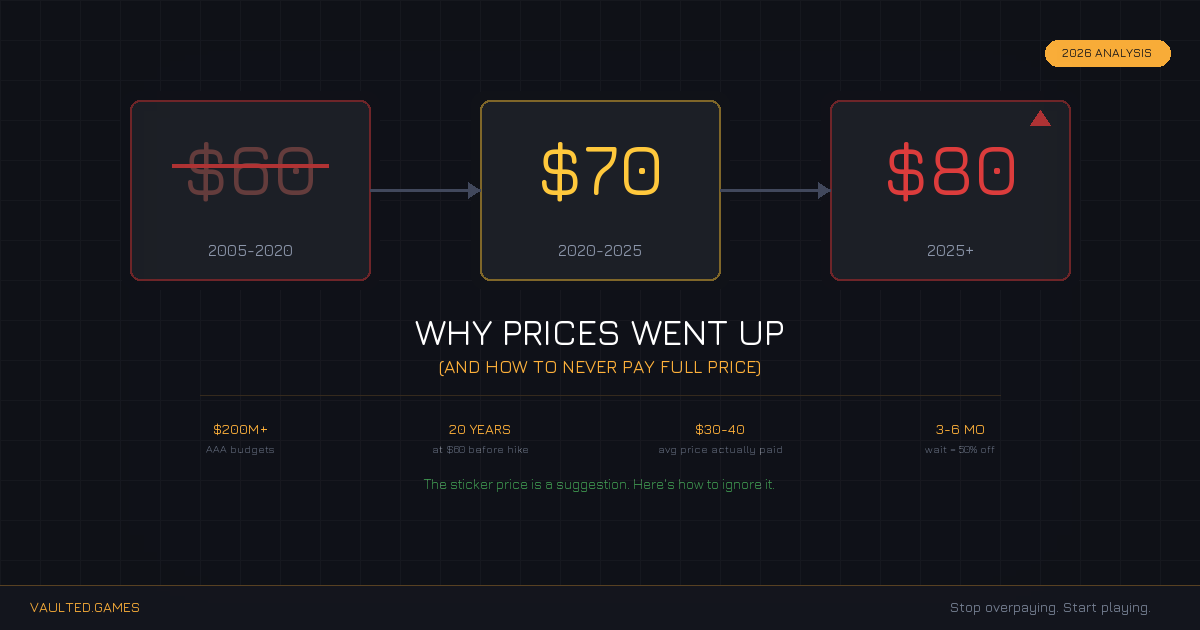
Remember when games were $60? That lasted nearly 20 years. Then in 2020, the dam broke.
2K bumped NBA 2K21 to $70 on next-gen consoles. Sony followed with PS5 launch titles. By 2023, $70 was the new normal for AAA games. And now? Some publishers are testing $80.
If you're frustrated about it, you're not alone. But here's the thing: you don't have to pay these prices. Most gamers don't. The average price actually paid per game is closer to $30-40 once you factor in sales, subscriptions, and patience.
Here's what's driving prices up, whether it's actually justified, and how to make sure you never pay full price again.
Quick Answer: Why Did Game Prices Go Up?
Two reasons: Development costs exploded, and the $60 price point was artificially frozen for 20 years.
AAA game budgets have ballooned from $50-100 million a decade ago to $200-300 million+ for top-tier titles today. Grand Theft Auto VI reportedly has a budget exceeding $2 billion when marketing is included. Team sizes have grown from hundreds to thousands. Development cycles stretch 5-7 years for major releases.
Meanwhile, $60 in 2005 is roughly $95 in 2026 dollars when adjusted for inflation. So technically, games are still cheaper than they were 20 years ago in real terms.
Does that justify $70-80? That's debatable. Let's dig in.
The Real Reasons Games Cost More
1. Development Costs Have Skyrocketed
Making a modern AAA game is absurdly expensive:
| Era | Avg. AAA Budget | Team Size | Dev Timeline |
|---|---|---|---|
| PS2/Xbox era (2001-2005) | $5-20M | 50-150 people | 2-3 years |
| PS3/360 era (2006-2012) | $20-60M | 100-300 people | 3-4 years |
| PS4/XB1 era (2013-2019) | $50-150M | 200-500 people | 3-5 years |
| PS5/XSX era (2020-2026) | $100-300M+ | 500-3,000+ people | 4-7 years |
Players expect photorealistic graphics, massive open worlds, full voice acting in multiple languages, motion capture, orchestral soundtracks, and hundreds of hours of content. That costs money.
The problem: Not every game needs a $200M budget. But the market increasingly punishes mid-budget games. Players compare everything to the biggest releases, and anything that doesn't match gets called "not worth $70."
2. The $60 Price Point Was Frozen for 20 Years
Games have been $60 since the Xbox 360 launched in 2005. Before that, N64 games were $50-70, and SNES games were sometimes $70-80 in 1990s dollars.
Adjusted for inflation:
- $60 in 2005 = ~$95 in 2026
- $50 in 1996 = ~$100 in 2026
By that math, $70 in 2026 is actually cheaper than what we paid in the 90s. Publishers love pointing this out. They're not wrong on the numbers, but they conveniently ignore the next section.
3. Revenue Has Never Been Higher (The Part Publishers Don't Mention)
Here's where the "we need to charge more" argument falls apart:
The gaming industry generated over $180 billion in revenue in 2025. That's more than movies and music combined.
Publishers aren't just selling base games anymore. They're selling:
- Microtransactions and in-game purchases (the biggest revenue driver for many publishers)
- DLC and season passes ($30-50 per game)
- Battle passes ($10-15 per season, multiple seasons per year)
- Cosmetic items (skins, emotes, etc.)
- Deluxe/Ultimate editions (see below)
EA makes more money from Ultimate Team in FIFA/EA FC than from game sales. Activision's Call of Duty generates billions from in-game purchases annually. GTA Online has made over $8 billion since launch.
The base game price going from $60 to $70 isn't because publishers are struggling. Total revenue per player has increased dramatically. The $70 price tag is about margins, not survival.
4. The Deluxe Edition Creep
This is the pricing trend that should bother you most:
| Edition | Typical Price | What's Included |
|---|---|---|
| Standard | $69.99 | Base game |
| Deluxe | $79.99-89.99 | Base game + cosmetics + minor extras |
| Ultimate | $99.99-109.99 | Base game + season pass + cosmetics |
| Collector's | $149.99-249.99 | Physical items + everything above |
The "Standard" edition is increasingly becoming the budget option. Publishers design the tiers to make the middle option feel like the "value" choice, pushing average transaction prices well above $70.
The worst part? Some games gate actual gameplay content behind higher tiers. Early access periods (play 3-7 days before standard edition buyers) are now common in the $90-110 tier. You're paying $30-40 extra to play a game a few days sooner.
Is $70 Actually Justified?
The honest answer: For some games, yes. For most, no.
A game like Elden Ring or Baldur's Gate 3 that delivers 100+ hours of content with no microtransactions? $70 is fair. You're paying less than a dollar per hour of entertainment.
A game that charges $70 upfront, then sells a $50 season pass, $10 battle passes every three months, and a cosmetic shop with $20 skins? That's not a $70 game. That's a $200+ investment dressed up as a $70 purchase.
The question isn't "is $70 fair?" The question is: "What are you actually getting for $70, and is the publisher going to ask for more money after you've already paid?"
How to Never Pay Full Price
You don't have to participate in $70-80 pricing. Most gamers don't. Here's how.
1. The 3-6 Month Rule
Most AAA games drop 30-50% within 3-6 months. That $70 game will be $35-49 before you know it. Unless it's a multiplayer game where community size matters on day one, waiting costs you nothing.
2. Use Subscription Services
Game Pass, PS Plus Extra, and EA Play give you access to hundreds of games for a monthly fee. Many day-one releases hit Game Pass immediately. PS Plus Extra adds major titles 6-12 months after launch.
If you're playing 5+ games per year, a subscription often costs less than buying them individually. We broke down the math in our subscription comparison guide.
3. Set Price Alerts
Don't hunt for deals. Let deals come to you. Set your target price and get notified when it drops. Vaulted.Games tracks prices across platforms so you never miss a sale.
4. Buy During Major Sales
Every platform has predictable sale events. Steam Summer/Winter sales, PlayStation Days of Play, Black Friday across everything. Know when they happen, and plan your purchases around them. Our Steam sale calendar has every 2026 date mapped out.
5. Skip Deluxe Editions
The standard edition is almost always enough. Cosmetic items aren't worth $20-40 extra. If the game has a season pass you want, it'll go on sale separately later for less than the upfront premium.
The one exception: If early access (playing days before launch) genuinely matters to you and you've confirmed the game is good from previews, the premium might be worth it. But this is rare.
6. Buy Physical and Resell
Physical games can be resold after you finish them. A $70 game resold for $40 is effectively a $30 rental. We covered this in detail in our physical vs digital comparison.
7. Use Reward Programs
Free money you're probably not collecting:
- Microsoft Rewards: Earn points from Bing searches and Game Pass quests, redeem for Xbox/Microsoft Store credit
- PlayStation Stars: Earn points from purchases and campaigns, redeem for PSN credit
- Steam Points: Not directly redeemable for games, but Steam trading cards can be sold for wallet credit
- Humble Bundle Choice: Monthly game bundles at deep discounts, often featuring recent AAA titles
What the Average Gamer Actually Pays
Despite $70 being the sticker price, most gamers pay significantly less:
| Buying Method | Avg. Price Paid | Savings vs. MSRP |
|---|---|---|
| Launch day purchase | $69.99 | 0% |
| 3-month sale | $45-50 | 29-36% |
| 6-month sale | $30-35 | 50-57% |
| Subscription (per game) | $10-15 | 79-86% |
| Physical resale (net) | $20-30 | 57-71% |
| Bundle (Humble, etc.) | $5-15 | 79-93% |
The takeaway: The $70-80 price tag is the ceiling, not the floor. Patient gamers pay less than half of MSRP on average.
The Future of Game Pricing
Where is this heading?
More $80 games are coming. Some publishers are already testing it, and if sales hold up, others will follow. The "standard" price will likely settle at $79.99 within the next few years for top-tier AAA releases.
Subscriptions will keep growing. Game Pass, PS Plus, and similar services are becoming the primary way many gamers access new titles. This shifts the equation from "buy or don't buy" to "is my subscription worth it?"
Free-to-play will continue dominating revenue. The biggest earners in gaming (Fortnite, Genshin Impact, Roblox) are free to play. The paid game market is a smaller piece of a growing pie.
The silver lining: Competition between storefronts, subscriptions, and platforms means more sales, more deals, and more ways to play for less. You just have to be strategic about it.
The Bottom Line
Games cost $70-80 because development is genuinely expensive, the old price was frozen for two decades, and publishers know the market will bear it.
But you don't have to pay that price. Between sales, subscriptions, resale, and patience, the average actual cost per game is $30-40 for smart buyers.
Three rules to live by:
- Never buy at launch unless you'll play it that day and it's a genre where timing matters
- Use a subscription for day-one games you want but don't need to own
- Set price alerts and let deals come to you
The sticker price is a suggestion. Treat it like one.
Want help making sure you never overpay? Vaulted.Games tracks prices, monitors subscriptions, and sends alerts when games hit your target price across every platform.
Sources: Circana/NPD Game Industry Revenue Data, Newzoo Global Games Market Report 2025, IGN - History of Game Pricing, Bureau of Labor Statistics CPI Inflation Calculator