
Why Nintendo Games Never Go on Sale (And When They Actually Do)
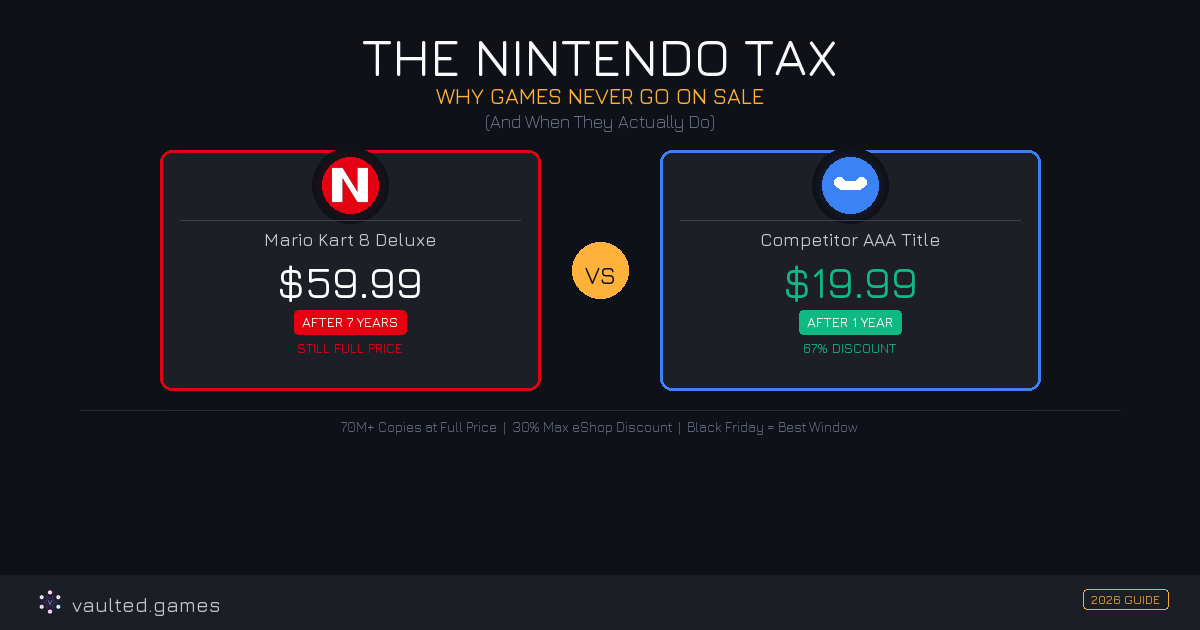
Mario Kart 8 Deluxe launched in 2017. It's still $59.99. Breath of the Wild came out the same year. Still $59.99 on the eShop. Animal Crossing: New Horizons? Five years old and sitting at full price.
Meanwhile, God of War Ragnarok was $25 within two years. Starfield was on Game Pass day one. What the hell, Nintendo?
If you've ever felt ripped off by Nintendo's pricing, you're not alone. The "Nintendo Tax" is real, it's frustrating, and it's not going anywhere. But there ARE windows where you can save money on Nintendo games if you know when and where to look.
What Is the "Nintendo Tax"?
The Nintendo Tax is the well-known phenomenon where Nintendo first-party games almost never drop in price. Not after six months, not after a year, not after half a decade.
Here's what that looks like in practice:
| Game | Launch Year | Current eShop Price | Years at Full Price |
|---|---|---|---|
| Mario Kart 8 Deluxe | 2017 | $59.99 | 7+ |
| The Legend of Zelda: Breath of the Wild | 2017 | $59.99 | 7+ |
| Super Mario Odyssey | 2017 | $59.99 | 7+ |
| Animal Crossing: New Horizons | 2020 | $59.99 | 5+ |
| Super Smash Bros. Ultimate | 2018 | $59.99 | 6+ |
Compare that to other platforms. God of War Ragnarok launched at $70 in November 2022 and hit $50 within two months. By 2024, it was under $25. Starfield was available on Game Pass the day it launched, meaning subscribers paid $0 extra to play it.
PlayStation and Xbox studios aggressively discount their games to drive volume. Nintendo doesn't. And the infuriating part? It works.
Why Nintendo Does This (And Why It Works)
Nintendo isn't stubborn or oblivious. Their pricing strategy is calculated, and the numbers back it up.
The Games Keep Selling at Full Price
Mario Kart 8 Deluxe has sold over 70 million copies lifetime. It sold another 6 million copies in 2024 alone, a decade after the original Wii U version launched. When your game is still moving millions of units at $60, why would you cut the price?
Most games from other publishers see the bulk of their sales in the first month, then fall off a cliff. Nintendo games sell steadily for years. They don't need discounts to move units.
Brand Perception
If a game is always $60, it always feels premium. There's no "I'll just wait for a sale" mindset because players know the sale probably isn't coming. This creates urgency to buy now instead of waiting, which is the exact opposite of how most gamers approach PlayStation or Steam purchases.
Smaller Catalog, Less Self-Competition
Nintendo publishes fewer games than Sony or Microsoft's studios. They're not competing with themselves for attention. When you only release a handful of first-party titles per year, each one gets more shelf life and sustained demand.
No Meaningful Used Game Pressure (Yet)
As digital purchasing grows, the used game market has less leverage over pricing. Nintendo doesn't have to compete with a $30 used copy at GameStop if more players are buying digital.
The bottom line: Nintendo's pricing strategy isn't anti-consumer on purpose. It's a business model that prints money because their games have evergreen appeal. That doesn't make it less annoying for your wallet, though.
When Do Nintendo Games Actually Go on Sale?
Nintendo games DO go on sale. It just happens less often and with shallower discounts than you'll see on any other platform. Here are the windows that matter.
Black Friday: The Best Deal You'll Get
This is the one reliable window every year where Nintendo actually slashes prices on first-party titles. In 2025, Walmart offered 50% off select Switch exclusives, with games like Princess Peach: Showtime!, The Legend of Zelda: Echoes of Wisdom, and Donkey Kong Country Returns HD dropping to $29.99.
That's as good as it gets. Mark your calendar for late November and plan your purchases around it.
Nintendo eShop Sales (Cyber Deals, Holiday Sales)
Nintendo runs a handful of digital sales per year. The Cyber Deals sale and Holiday Sale are the biggest ones. First-party titles typically top out at 30% off on the eShop, bringing $60 games down to about $41.99.
Third-party games on the eShop go on deep sale regularly (50-80% off), but first-party? 30% is the ceiling, and even that only happens a few times per year.
Nintendo Direct Tie-In Sales
When Nintendo announces something big during a Direct, they'll occasionally discount related games. These are small, unpredictable windows, but worth keeping an eye on.
End of Console Lifecycle
Here's the opportunity right now. With Switch 2 already on the market, Switch 1 games are in that end-of-life window. Black Friday 2025 already showed deeper discounts than we've seen before. Retailers want to clear Switch 1 inventory, and that means deals.
Don't expect Nintendo's eShop prices to budge much, but physical copies from retailers like Walmart, Target, and Amazon could see real price drops as shelf space shifts to Switch 2 titles.
Physical Retailer Deals
Walmart, Target, Best Buy, and Amazon occasionally offer prices that beat the eShop. Physical copies of Nintendo games regularly go lower than digital during sales events. This is especially true during Black Friday, Prime Day, and holiday clearance.
Are Switch Games Cheaper on the eShop?
Short answer: Usually no for first-party games. Yes for third-party during sales.
This might be the most common misconception about Nintendo games. Players assume digital should be cheaper since there's no disc, case, or shipping. But Nintendo prices digital and physical identically at $59.99, and the eShop rarely offers better deals than physical retailers.
For first-party Nintendo games, physical copies are often the cheaper option because:
- Retailers run their own promotions (Black Friday, clearance, price matching)
- Used physical copies are the cheapest path to Nintendo games, period
- Physical games hold resale value extremely well (you can sell a used copy of Mario Kart 8 Deluxe for $35-40)
Where digital wins is third-party titles. Indie games and third-party publishers run frequent, deep discounts on the eShop (50-80% off is common). And of course, digital means no cartridge swapping, which has its own value.
For a deeper look at the physical vs digital debate across all platforms, check out our Physical vs Digital Games: Which Is Actually Cheaper? breakdown.
My Nintendo Gold Points: The Hidden (But Shrinking) Discount
My Nintendo Gold Points used to be a decent way to save a few bucks on digital purchases. Here's the deal in 2026.
How They Worked
You earned 5% back on digital eShop purchases as Gold Points and 1% back on physical game registrations. Those points could then be applied as a discount on future digital purchases. 100 Gold Points = $1.00.
What Changed
As of March 24, 2025, digital Switch software no longer earns Gold Points. Physical games released before that date can still earn points if registered within a year of the game's release date. And as of January 30, 2026, you can no longer purchase new Game Vouchers.
So the Gold Points system is effectively winding down for Switch 1. If you still have points, use them before they expire. Points are only valid for 12 months after you earn them.
Stacking Points with Sales
If you still have Gold Points banked, the smart move is to combine them with an eShop sale. A 30% off first-party game plus Gold Points applied at checkout is the best digital deal you'll get from Nintendo directly.
Physical vs Digital for Switch (and Switch 2)
This matters more for Nintendo than any other platform because of the pricing dynamics.
Physical Wins on Price for Nintendo
Physical copies get retailer discounts that digital doesn't. Black Friday, clearance sales, and everyday price matching mean physical often beats digital by $10-20 on first-party titles.
Physical Holds Resale Value
This is huge for Nintendo specifically. A used copy of most Nintendo first-party games sells for $30-45 on the secondhand market, even years after launch. Buy a game for $60, finish it, sell it for $40. That's a $20 rental. Try doing that with a digital purchase.
Digital Wins on Convenience and Indie Sales
No cartridge swapping, no worrying about losing tiny game cards, and third-party/indie games get much better digital deals. If you're buying indie titles, digital is the move.
Switch 2 Continues Physical Support
Switch 2 supports physical cartridges and is backwards compatible with most Switch 1 physical games. So your investment in physical carries forward.
One thing to watch: Switch 2 first-party games are launching at $70-80 (up from $60 on Switch 1). Mario Kart World launched at $80. That makes the physical vs digital calculation even more important, because every dollar saved matters more at higher price points.
For the complete breakdown across all platforms, read our guide on Physical vs Digital Games: Which Is Actually Cheaper?.
Typical First-Party Nintendo Discount Patterns
Here's a realistic view of what discounts you can actually expect on a Nintendo first-party game:
| Time After Launch | Typical Price | Best Case Price | Where |
|---|---|---|---|
| 0-6 months | $59.99 | $49.99 (rare) | Retailer promo |
| 6-12 months | $59.99 | $41.99 | eShop sale (30% off) |
| 1-2 years | $59.99 | $29.99 | Black Friday at retailers |
| 3+ years | $59.99 | $29.99 | Black Friday / clearance |
| End of lifecycle | $59.99 | $29.99 | Retailer clearance |
Notice how the "Typical Price" column barely moves. That's the Nintendo Tax in action. The best-case scenarios require patience, timing, and knowing where to look.
Compare this to a typical PlayStation or Xbox first-party title, where you'd see $40 within 3 months, $30 within 6 months, and $20 within a year. Nintendo plays by completely different rules.
The Smart Nintendo Buyer's Playbook
Here's the cheat sheet. Follow this and you'll save the most money possible on Nintendo games.
1. Buy physical for first-party games. Physical gets retailer discounts, holds resale value, and gives you a backup plan if you want to sell later.
2. Wait for Black Friday. This is your best shot at first-party discounts. Plan your big Nintendo purchases for late November.
3. Check eShop Cyber Deals and Holiday Sales. If you prefer digital, these are the 2-3 times per year where first-party titles might hit 30% off.
4. Buy used for older titles. A used copy of Super Mario Odyssey costs $30-35 and plays identically to a new one. No shame in it.
5. Track prices across platforms. Nintendo's pricing makes tracking even more important than other platforms. When a first-party game actually goes on sale, you need to know about it immediately because the window is short.
6. Take advantage of the Switch 1 end-of-life window. Retailers are clearing Switch 1 inventory right now. If there are Switch 1 games you want, this is one of the best buying windows we've seen.
7. Sell physical games you're done with. Nintendo games hold value better than any other platform. Selling a finished game for $35-40 effectively reduces what you paid.
Want to stop manually checking prices across Nintendo, Steam, PlayStation, and Xbox? Vaulted.Games tracks prices across all platforms and sends you alerts when games hit your target price. Set it and forget it until the deal shows up.
Key Takeaways
- The Nintendo Tax is real. First-party games stay at $59.99 for years. Don't expect that to change.
- Black Friday is the best window. 2025 saw first-party Switch games hit $29.99 at retailers, the deepest discounts we've seen.
- Physical beats digital for first-party Nintendo. Retailer deals, resale value, and price matching make physical the smarter buy.
- eShop caps first-party discounts at ~30%. Third-party games get deep digital discounts. First-party does not.
- Switch 1 end-of-life is a buying opportunity. Retailers clearing inventory means better deals on the games you've been holding out on.
- Switch 2 games cost even more ($70-80). The Nintendo Tax just got more expensive. Smart buying matters more than ever.