

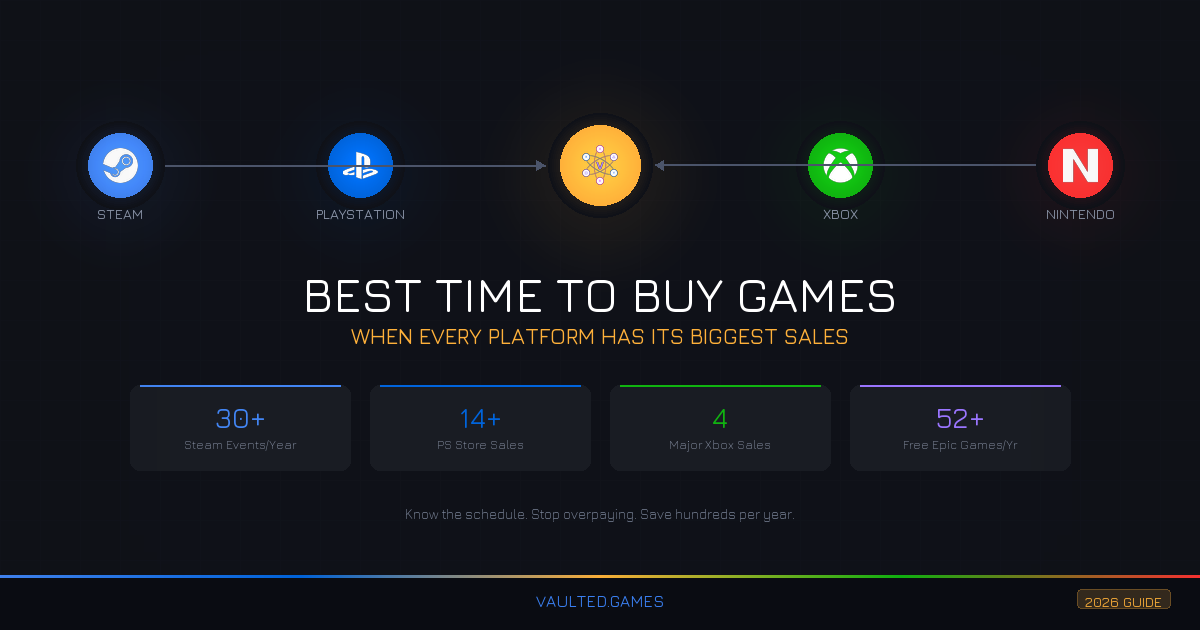
Best Time to Buy Games: When Every Platform Has Its Biggest Sales
You just bought a game for $70 and it's 40% off two weeks later. We've all been there, and it sucks.
The thing is, game sales aren't random. Every platform follows a pattern. Steam has its seasonal sales locked in months ahead of time. PlayStation runs roughly 14 named sales per year. Xbox drops weekly deals like clockwork. Even Nintendo, the stingiest platform on the planet when it comes to first-party pricing, has predictable windows where you can actually save money.
If you know the schedule, you stop getting burned. So here's the complete breakdown of when every major platform has its biggest sales, how often games go on discount, and when you should actually pull the trigger versus when you should wait.
How Often Does Steam Have Sales?
Short answer: Constantly. Steam runs 4 major seasonal sales, 3 Next Fest events, 22+ themed genre festivals, and rolling daily/weekly/weekend deals throughout the year. There are over 30 sale events annually, and that's before counting publisher sales.
The Big Four Seasonal Sales
These are the ones everybody knows about. Store-wide events where thousands of games get discounted, and Steam's normal 30-day cooldown between custom discounts gets waived.
| Sale | Typical Dates | Duration | Avg. Discount |
|---|---|---|---|
| Spring Sale | Mid-to-late March | 1 week | 50-60% |
| Summer Sale | Late June to early July | 2 weeks | ~67% |
| Autumn Sale | Early October | 1 week | 50-60% |
| Winter Sale | Mid-December to early January | ~2.5 weeks | ~58% |
The Summer Sale typically has the deepest discounts, averaging around 67% off. It's the best time to scoop up older titles and indie games at rock-bottom prices. The Winter Sale moves the most volume ($270M+ compared to $236M+ for Summer) and is your best bet for first-time discounts on newer releases that launched earlier that year.
Between the Big Sales
Steam doesn't just go quiet between seasonal events. Here's what runs year-round:
Daily Deals rotate at 10 AM Pacific with at least 2 featured games. The actual discounts run 7-14 days, but the homepage spotlight is 24 hours. Midweek Deals feature up to 6 games Monday through Thursday. Weekend Deals spotlight up to 6 games Thursday through Monday. And publisher sales from companies like Capcom, Ubisoft, and EA pop up throughout the year independently of Valve's schedule.
Steam's 30-Day Rule
Here's a detail most people miss: Steam requires at least 30 days between custom discounts for any game. Games also can't be discounted within 30 days of release. But the four major seasonal sales are exempt from this cooldown. So even if a game was just on sale two weeks ago, it can still show up discounted in the Summer Sale.
How Often Do Steam Games Actually Go on Sale?
For any individual game, expect it to go on sale roughly every 4-6 weeks once it's past the initial launch window. Between seasonal sales, themed festivals, publisher events, and weekly deals, most games cycle through discounts regularly. The trick is knowing whether the current price is actually good or if a deeper cut is coming.
How Often Do PS5 Games Go on Sale?
PlayStation Store runs approximately 14 named sale events per year, plus a rotating "Deal of the Week" and "Weekend Offer" section that refreshes every Tuesday.
The Major PlayStation Sales
| Sale | Typical Timing | What to Expect |
|---|---|---|
| New Year Deals | Late January | 2 weeks of discounts on recent and classic titles |
| Critics' Choice | Early February | Award-winning and critically acclaimed games |
| Spring Sale | Late March/Early April | ~10 days, broad catalog discounts |
| Days of Play | Late May to mid-June | The biggest PS Store sale of the year. 2 weeks, includes hardware/accessory deals |
| Summer Sale | Mid-July to early August | ~2 weeks of deep discounts |
| Halloween Sale | Mid-to-late October | Horror and thriller titles featured |
| Black Friday Sale | Late November | ~1 week, major releases heavily discounted |
| Winter Holiday Sale | Mid-December to early January | Longest sale, deepest discounts of the year |
There are also smaller events throughout the year like the Valentine's Sale, Next Level Savings, Game Fest Sale, Ready Set Play Sale, Autumn Adventures, and a Game Awards Flash Sale. You're rarely more than 3-4 weeks from some kind of PS Store discount event.
PS Store Discount Patterns
First-party PlayStation exclusives (God of War, Spider-Man, The Last of Us) typically see their first discount within 2-3 months of launch, usually around 20-30% off. By 6 months, you can regularly find 40-50% off. Within a year, many hit $20-30.
Third-party AAA titles move even faster. It's not unusual to see 25-30% off within the first month during a well-timed sale event.
PS Plus members get extra perks during sales. During events like the Spring Sale, PS Plus subscribers often get early access (sometimes 24-48 hours) and occasionally exclusive deeper discounts on select titles.
When Do PS Store Deals Refresh?
New deals typically go live on Tuesdays. The Deal of the Week and Weekend Offer sections rotate on this schedule. If you're checking the store for new discounts, Tuesday is your day.
How Often Do Xbox Games Go on Sale?
Xbox runs weekly deal rotations plus several major seasonal sales. Game Pass subscribers (Essential, Premium, and Ultimate tiers) also get member-exclusive discounts of up to 50% off select titles through what used to be called Deals with Gold.
Major Xbox Sales
| Sale | Typical Timing | Scale |
|---|---|---|
| Spring Sale | Mid-to-late April | 1,000+ games, savings up to 70% |
| Ultimate Game Sale | Mid-July | One of the biggest annual events |
| Black Friday Sale | Late November | Discounts up to 75% on games, 85% on PC titles |
| Countdown Sale | Late December to early January | 2,000+ games discounted |
Beyond these, Xbox runs Golden Week Sale (late April, focused on Japanese titles), indie-focused sales, and publisher spotlights throughout the year.
Xbox Weekly Deals
Like PlayStation, Xbox refreshes deals on a weekly basis. Game Pass members get exclusive discounts that non-subscribers don't see, which adds extra value on top of the catalog access. These deals rotate regularly and can stack with seasonal sale pricing during major events.
Game Pass Changes the Math
Here's where Xbox is different from every other platform. With Game Pass, many games are available day one at no additional cost beyond your subscription. Microsoft's first-party titles (Starfield, Forza, Halo) all launch on Game Pass. So the "best time to buy" question becomes "do I even need to buy this, or is it on Game Pass?"
For games that leave Game Pass, subscribers get a 20% discount if they want to purchase before removal. And Game Pass members get member pricing on most store purchases year-round.
How Often Do Nintendo Switch Games Go on Sale?
Rarely, and shallowly. That's the honest answer for first-party titles. Nintendo is the one platform where the standard pricing rules don't apply.
The Nintendo Tax in Numbers
Mario Kart 8 Deluxe launched in 2017. It's still $59.99 on the eShop. Breath of the Wild? Same year, same price. Animal Crossing: New Horizons? Five years old and still full price. Meanwhile, PlayStation and Xbox exclusives are half price within months.
When Nintendo Games Actually Go on Sale
| Window | Typical Discount | Where |
|---|---|---|
| Black Friday | Up to 50% off at retailers | Walmart, Target, Best Buy |
| eShop Cyber Deals | Up to 30% off first-party | Nintendo eShop |
| eShop Holiday Sale | Up to 30% off first-party | Nintendo eShop |
| Nintendo Direct tie-ins | Small, unpredictable discounts | eShop |
| End of console lifecycle | Retailer clearance pricing | Physical retail |
Black Friday is the single best time to buy Nintendo first-party games. In 2025, Walmart offered 50% off select Switch exclusives, bringing games like Princess Peach: Showtime! and The Legend of Zelda: Echoes of Wisdom down to $29.99. That's as good as it gets.
On the eShop directly, first-party Nintendo titles cap out at about 30% off, bringing a $60 game to roughly $42. Third-party titles on the eShop go on deep discount regularly (50-80% off), but Nintendo's own games play by different rules.
Physical Beats Digital for Nintendo
This matters more for Nintendo than any other platform. Physical copies at retailers like Walmart, Target, and Amazon regularly beat eShop prices during sales events, and they hold resale value incredibly well. A used copy of most first-party Nintendo games sells for $30-45 on the secondhand market. Buy physical, play it, sell it for $35-40. That's a $20 rental.
For a deep dive into Nintendo's pricing strategy and every trick to save money on Switch games, check out our full guide on why Nintendo games never go on sale.
Epic Games Store Sale Schedule
Epic runs 7-9 major sale events per year plus weekly free game giveaways that make it worth keeping installed even if you never buy anything.
Major Epic Sales
| Sale | Typical Timing | Notable Feature |
|---|---|---|
| Winter Sale | Early-to-mid February | 2+ weeks |
| Spring Sale | Late March to early April | ~2 weeks, 10-75% off |
| Mega Sale | Mid-May to mid-June | The big one. ~1 month, coupons stack on top of discounts |
| Summer Sale | Late July | ~2 weeks |
| Halloween Sale | Late October | Horror-focused |
| Black Friday Sale | Late November | ~1 week |
| Game Awards Sale | Early December | ~2-3 days, award nominees |
| Holiday Sale | Mid-December to early January | Deepest discounts of the year, unlimited coupons |
The Epic Mega Sale Coupon Trick
The Mega Sale (typically May/June) is Epic's crown jewel. Not only do games go on sale, but Epic issues coupons (historically $10 off purchases of $14.99+) that stack on top of existing discounts. So a game that's already 40% off gets an additional $10 knocked off at checkout. You can use the coupon, get a new one, and repeat. It's genuinely the best deal in PC gaming during that window.
The Holiday Sale (December) also usually features unlimited coupons, making it the other top-tier Epic event.
52+ Free Games Per Year
Epic gives away at least one free game every single week, all year long. During the Holiday season, they switch to daily giveaways (one free game every 24 hours for about 2-3 weeks). In 2025, they gave away titles like Dead Island 2, Dragon Age: Inquisition GOTY, and Farming Simulator 22 for free.
You don't have to spend a dime on the Epic Games Store to build a solid library. Just claim the free games weekly and check back during the Mega Sale and Holiday Sale for anything else you want.
The Universal Sale Calendar: Month-by-Month
Here's when the biggest opportunities hit across all platforms. This is the reference chart you bookmark.
| Month | Steam | PlayStation | Xbox | Nintendo | Epic |
|---|---|---|---|---|---|
| January | Genre festivals | New Year Deals | Countdown Sale (cont.) | New Year Sale | - |
| February | Genre festivals, Next Fest | Critics' Choice, Valentine's Sale | Indie sales | - | Winter Sale |
| March | Spring Sale, festivals | Spring Sale | - | - | Spring Sale |
| April | Genre festivals | Next Level Savings | Spring Sale, Golden Week | - | - |
| May | Genre festivals | Days of Play begins | - | - | Mega Sale begins |
| June | Next Fest, Summer Sale begins | Days of Play ends, Game Fest | - | - | Mega Sale ends |
| July | Summer Sale ends, festivals | Summer Sale | Ultimate Game Sale | - | Summer Sale |
| August | Genre festivals | Ready Set Play | - | - | - |
| September | Genre festivals | Autumn Adventures | - | - | - |
| October | Autumn Sale, Next Fest, Steam Scream | Halloween Sale | - | - | Halloween Sale |
| November | Genre festivals | Black Friday Sale | Black Friday Sale | Black Friday (retailers) | Black Friday Sale |
| December | Winter Sale | Winter Holiday Sale | Countdown Sale | eShop Holiday Sale | Game Awards, Holiday Sale |
The three biggest months for deals across all platforms: June (Summer sales kick off), November (Black Friday everything), and December (Holiday/Winter sales everywhere).
How Long Until a New Game Gets Its First Discount?
This is probably the most useful data point for deciding whether to buy now or wait. Research analyzing pricing data from highly-rated AAA games found consistent patterns.
AAA Games (PlayStation, Xbox, PC)
| Time After Launch | Typical Discount | What That Looks Like |
|---|---|---|
| 0-30 days | 0% (usually) | Steam's 30-day cooldown prevents discounts. Consoles occasionally see small launch-week deals. |
| ~2 months | 20-25% | First discount appears. A $70 game drops to $52-56. |
| 3-4 months | 25-35% | Regular sale pricing kicks in. $70 becomes $45-52. |
| 6-7 months | 40-50% | The sweet spot. $70 becomes $35-42. |
| 12 months | 55-70% | Deep discounts. $70 becomes $21-31. |
| 18+ months | 75-85% | Bargain bin territory. Under $15 for most titles. |
The 7-month mark is where the math really tips. On average, popular AAA games hit 50% off after about 7 months. If you're not desperate to play something on day one, waiting half a year saves you roughly $35 on a $70 game. Over 6 purchases a year, that's $210 back in your pocket.
Indie Games
Indie games follow a slightly different pattern. They typically launch at $15-30 and breakout hits actually take longer to hit deep discounts (about 9.2 months to reach 50% off on average). But smaller indie titles that aren't chart-toppers tend to discount faster and more aggressively, sometimes within the first Steam seasonal sale after launch.
The genre festivals on Steam are particularly good for indie deals. If there's a themed festival that matches your game's genre, expect it to show up discounted there.
Nintendo First-Party Games
Nintendo is the exception to every rule above. First-party titles stay at $59.99 for years. The best case scenario is 30% off on the eShop (about $42) or 50% off at physical retailers during Black Friday ($30). There is no reliable 7-month price drop. There is no gradual decay curve. It's full price or wait for Black Friday. That's essentially it.
The Best Day of the Week to Check for Deals
If you want to stay on top of rotating deals without obsessively checking every platform:
Tuesday is the day. Both Steam and PlayStation refresh their weekly deals on Tuesdays. Steam's Midweek Madness deals go live, and PlayStation's Deal of the Week rotates. Xbox refreshes deals regularly throughout the week but tends to spotlight new promotions early in the week as well.
Set a reminder for Tuesday mornings. Take 5 minutes to check Steam's specials page, the PS Store deals section, and Xbox's sales page. That's all it takes to stay current on weekly rotations without making it a second job.
Platform-by-Platform Cheat Sheet
Here's the quick-hit summary for each platform. What you need to know, nothing extra.
Steam
Sale frequency: 30+ events per year. Best time to buy: Summer Sale (deepest discounts) or Winter Sale (newest titles on sale). How often individual games go on sale: Every 4-6 weeks after launch window. Secret weapon: Publisher sales and genre festivals between major sales often match seasonal pricing for specific titles.
PlayStation Store
Sale frequency: ~14 named sales per year plus weekly Deal of the Week. Best time to buy: Days of Play (May/June) and Winter Holiday Sale (December). How often individual games go on sale: First-party within 2-3 months, third-party often within weeks. Secret weapon: PS Plus early access to sales and member-exclusive discounts.
Xbox / Microsoft Store
Sale frequency: 4-5 major sales plus weekly Game Pass member deals. Best time to buy: Depends. If it's on Game Pass, you might not need to buy at all. For purchases, Black Friday and Countdown Sale (December) are the biggest. Secret weapon: Game Pass member pricing gives year-round discounts on purchases, stacking with sale prices.
Nintendo eShop
Sale frequency: 3-4 meaningful first-party sales per year. Third-party goes on sale much more often. Best time to buy: Black Friday at physical retailers, period. How often first-party games go on sale: 2-3 times per year at best, capped at 30% off on the eShop. Secret weapon: Physical copies and the used game market. Nintendo games hold value, which means you can buy, play, and resell for near what you paid.
Epic Games Store
Sale frequency: 7-9 major sales per year plus weekly free games. Best time to buy: Mega Sale (May/June) and Holiday Sale (December) with stackable coupons. How often individual games go on sale: Similar to Steam for shared titles. Secret weapon: The coupon system during Mega Sale and Holiday Sale. $10 off a $14.99+ purchase, unlimited uses. Combined with an existing discount, you can get absurd deals.
Stop Guessing, Start Tracking
Here's the bottom line. Every platform has a rhythm, and now you know it. But memorizing sale dates only gets you so far. What you really need is a way to set your target price for a game and get notified when it hits that number, across any platform, without checking five different stores every week.
That's what Vaulted.Games does. Track prices across Steam, PlayStation, Xbox, and Nintendo. Set alerts. Get notified when the deal is actually worth it. No more missed sales, no more buyer's remorse, and no more paying full price two weeks before a discount.
Related Articles
- Every Steam Sale in 2026: The Complete Schedule
- Why Nintendo Games Never Go on Sale (And When They Actually Do)
- The Gamer's Budget Guide: How to Spend Less Without Playing Less
- Physical vs Digital Games: Which Is Actually Cheaper?